Artful Tree Pruning & Crown Shaping for Structure and Health
Walk through any neighborhood with mature trees and you can tell, within a block, where careful hands have guided growth. Branches flow from strong unions, the canopy breathes, and the tree moves with wind rather than fighting it. Good pruning is precise, quiet work, like editing a manuscript. It removes clutter without losing the voice of the tree. Done well, it makes a tree safer, longer lived, and easier on the infrastructure around it. Done poorly, it invites decay, breaks, and a cycle of expensive fixes.
I have spent seasons shaping street maples wedged between power lines, training young oaks in new subdivisions, restoring storm-damaged cedars, and counseling owners who inherited topped trees. The principles remain consistent, but the judgment varies with species, age, site, and the goals of the property owner. This guide gathers what matters most when it comes to Tree Pruning & Crown Shaping, framed by the biology of trees and the realities of yards, sidewalks, https://simonpiwj992.image-perth.org/rapid-response-emergency-tree-services-near-you and weather.
What crown shaping actually means
Crown shaping aligns a tree’s architecture with its biology and the space it occupies. It is not a haircut. The aim is to select and reinforce a dominant leader where appropriate, build sound branch attachments with good spacing, and distribute foliage so that light, wind, and weight are handled gracefully. In practice, that means carefully removing live branches to refine form, not shearing the exterior into a ball or flattening the top. Most species respond best to reduction and thinning that respects natural habit. You encourage a beech to be a better beech, you do not try to turn it into a boxwood.
A crown shaped on structural principles resists failure. Trees rarely fail because they are tall. They fail at weak unions, overextended limbs with disproportionate weight, and decayed tissue around improper cuts. When a canopy looks light and even, that usually reflects hidden strength, not superficial grooming.
How trees heal, and why your cuts matter
Trees do not heal, they compartmentalize. When you cut, the tree walls off the wound, laying down callus tissue from the edges. The smaller the cut, the faster the closure and the lower the risk of decay. That one sentence is the spine of good pruning.
Cuts must be on the branch side of the branch collar, the slight swelling at the base where branch meets trunk or parent limb. Cut flush to the trunk and you remove the collar, which slows closure and opens a highway for pathogens. Leave a stub and you create deadwood that draws decay inward. On larger limbs, use a three-cut method, with a preliminary undercut and top cut to prevent tearing, then a final cut at the collar. Smooth surfaces are not the goal. Correct placement is.
I have returned to trees five years after these cuts and seen the clean, donut-like roll of callus closing evenly. On trees where a previous owner ripped heavy limbs or cut flush, the roll is uneven and the wood behind often spongy. You can fake a topiary, you cannot fake the biology.
Timing and the quiet art of restraint
Most temperate trees tolerate pruning any time outside of leaf flush and extreme heat. Late winter into early spring, before bud break, is an ideal window. Wounds close quickly as growth begins, structure is visible without leaves, and you can get equipment onto frozen or firm ground without compaction. Summer pruning has its place for slowing vigorous growth on species like silver maple or willow, since removing some foliage reduces energy. Fall is generally poor. Fungi release spores, and trees redirect resources to roots, not wound closure.
There are exceptions. Birches, maples, walnuts, and magnolias bleed sap if pruned late winter. They are not harmed, but it is messy and can attract insects. If you care about aesthetics, wait until early summer. Oaks deserve special caution in regions with oak wilt. Limit pruning to cold months, and paint large cuts immediately in outbreak areas as directed by local authorities. A Certified Arborist Consultation is valuable when timing intersects with disease concerns. Local experience beats generic calendars.
Restraint matters as much as timing. Take no more than a quarter to a third of live foliage in a single session, and usually much less. Savvy practitioners limit themselves to 10 to 20 percent on mature trees. If a canopy is dense and flawed, plan a two to three year sequence. I once rehabilitated a linden that had been lion-tailed, foliage stripped back to the ends. We spent three seasons growing back interior shoots then selecting for structure, instead of hacking all at once and triggering more weak growth.
Structural pruning young trees: cheap insurance
Structural pruning on young trees is the bargain of arboriculture. You can correct future liabilities with pruners from the ground in minutes. Let it go for ten years and the same flaw requires ropes, rigging, and cuts measured in inches instead of millimeters.
Focus first on leader selection. Many trees, especially more vigorous species like Norway maple, sycamore, and ash, try to push competing leaders. You want one central leader on these. Select the strongest, most upright stem, then subordinate the others by reducing them back to laterals or removing them entirely if small enough. On trees with a natural multi-stem habit, like river birch or some crape myrtles, you build a stable union between the chosen stems through spacing and reduction, rather than forcing a single spear.
Next, set branch spacing. A good rule is to stagger main scaffold branches around the trunk, with 12 to 24 inches of vertical separation, depending on species and target size. Keep branch diameter less than half the trunk diameter at the point of attachment. Encourage wide angles. If a branch exits at a narrow V, it often includes bark trapped between the limbs, a weak bond that can split under load. You can even train angles with simple, temporary spacers or weights during the first couple of growing seasons.
I once planted a line of swamp white oaks along a windy ridge. By year three they wanted to bulk out with codominant stems. We selected a leader on each and subordinated the competitors with strategic reductions. Ten minutes per tree saved them from a lifetime of risk.
Mature trees: respect the history in the wood
Mature trees carry history in their form, and your cuts rewrite it. They also have different priorities. The goal seldom involves shaping an ideal textbook crown. It is to reduce risk, preserve health, and fit the tree to its site with the lightest hand possible.
Thinning for light and air matters, but not the way many think. Random removal to “let light through” often strips energy from the interior where leaves are most efficient. Targeted thinning focuses on crossing branches that rub, weak attachments, and small diameter interior twigs that can be removed to improve wind flow without emptying the canopy. Reduction cuts, which drop the length and leverage of an overextended limb by cutting back to a lateral that is at least a third the size of the parent, are safer and saner than heading cuts. A well placed 3 inch reduction cut on a long limb can reduce end weight by hundreds of pounds when the branch is laden with wet snow.
Crown raising has its place to clear paths, roofs, or sight lines, but be mindful not to turn the canopy into a green umbrella on a pole. Removing too much low foliage shifts the center of gravity up, invites sunscald on the trunk, and reduces the tree’s ability to taper and resist bending. If I have to raise, I do it in stages over years, and I leave enough lower laterals to rebuild taper.
Bad practices that haunt a tree for decades
Topping remains the most common and damaging error. Cut a 12 inch leader in half and the tree responds with a spray of weak shoots around the wound. These sprouts attach poorly, grow fast, and fail frequently. Topping also invites decay down the stub. When owners inherit topped trees, we convert those heading cuts into reduction cuts where possible, select a new leader from the sprouts, and plan staged reductions to regain structural coherence. It can take five to ten years.
Lion-tailing is second. Removing all inner foliage and leaving tufts at the ends looks clean to some eyes but sets up whips that lever and break. Interior leaves manage energy best and damp wind.
Finally, flush cuts and stubs. Both slow closure, increase decay, and compromise the tree’s long game. When you see long brown stubs with no callus, you are looking at an infection door.
Species temperament and common edge cases
Different species tolerate different approaches.
- Maples bleed in late winter, but tolerate reduction well if timed right. Avoid heavy spring work during sap flow if you care about aesthetics.
- Oaks need strict disease-aware timing in regions with oak wilt. Reduction cuts favored over thinning to limit wounds.
- Birches and beech resent aggressive pruning. Be conservative and time for early summer once leaves have hardened.
- Conifers are a different conversation. Many do not respond to cuts into old wood. On pines, reduce by cutting to buds or small laterals in the current year’s growth. On firs and spruces, cuts into bare wood rarely sprout new foliage.
Urban street trees face heat, drought, and root restriction. They often push epicormic shoots along the trunk and inner canopy, a sign of stress or over thinning. Treat the cause as much as the symptom, with soil improvement, mulch, and watering plans, not just cuts.
Storm-damaged trees present a judgment call. A cracked union in a silver maple over a driveway is not a candidate for a gentle tune. This is where Dangerous Tree Assessment and Removal matters. Some trees can be stabilized with Tree Cable and Bracing, especially when the union is sound but the leverage is high. For example, an old pear with a heavy lateral over a patio may keep its character if we reduce the limb and install a brace rod with an upper dynamic cable. Others, especially where decay hollows the trunk more than a third of the diameter, cross the line into Tree Removal Services. Removal can be a kindness when the alternative is a gnawing worry every windstorm.
The right sequence for a pruning day
Every good day in a canopy follows a rhythm. You do not jump in with a saw and start cutting whatever looks inconvenient.
- Walk the tree from root flare to crown, reading the trunk, bark, and branching pattern. Identify targets and defects. Confirm property goals and site constraints, including lines, roofs, and understory plantings.
- Establish safety and access. If traffic or power lines are involved, coordinate with appropriate authorities. Stage gear and rigging points cleanly to avoid damage to bark and understory.
- Remove dead, dying, and broken branches first. Deadwood is deceptively heavy and unpredictable. Clearing it early reduces hazards as you move higher.
- Address structural issues next. Reduce or remove competing leaders, correct crossing or rubbing branches, and subordinate overextended laterals to decrease leverage.
- Refine for clearance and balance. Raise the crown for required access in small increments and thin selectively to improve airflow, always prioritizing small cuts over large.
That sequence minimizes risk to the tree and to people working in it, and it keeps the crown readable as you go. I cannot overstate how much better outcomes are when a crew works top down with a clear plan rather than chasing whatever catches the eye.
Safety, neighbors, and when emergencies call the shots
Tree work looks serene from the ground. Up close, a limb at shoulder height can weigh 80 pounds, move unpredictably, and pin a climber or crush the wrong corner of a roof if rigging angles are sloppy. Professionals invest in training for good reason. A Certified Arborist Consultation is not just a sales call. It is an inspection that weighs defects, species habits, and site exposure.
When storms hit, priorities change. Emergency Tree Services triage by risk. If a split trunk points at a bedroom, the chainsaws start there. If a downed limb only drags a fence, it can wait a day. I maintain a simple rule for property owners who call during a storm: stay out of any space under a hung limb or with a charged line nearby, do not cut anything under tension, and photograph before moving debris for insurance. The most dangerous time is often during cleanup when adrenaline outpaces judgment.
When removal and restoration mix
Some trees do not belong where they are. A heaved sidewalk over the main gas line, a giant poplar two feet from a basement wall, or a cottonwood under an aging clay sewer lateral, these are time bombs. You can prune and brace only so much. Tree Removal Services become part of a thoughtful plan to plant better trees in better places.
Removal done well respects what comes next. Stump Removal & Grinding preps the site for replanting or hardscape. Grinding typically goes 6 to 12 inches below grade. On species with invasive roots or in small yards where grindings can mix heavily with soil, I recommend removing the bulk of the grindings and importing topsoil for new plantings. If you replant immediately, offset the new tree at least 3 to 6 feet from the old stump location, more if the species is allelopathic, like black walnut, which affects some plants around it.
I often pair a removal with a canopy restoration elsewhere on site. Losing one problematic tree and investing in training three young ones yields better shade and less risk within a few years.
Bracing, cabling, and when mechanical help earns its keep
Tree Cable and Bracing is not a cure, it is a seat belt. It limits movement during high loads so that a weak point does not tear. Static steel cables are installed high in the canopy, well above the defect, with lag or through-bolts depending on limb diameter and condition. Dynamic systems use synthetic rope that allows some movement, better for trees that need to sway to build strength.
I tend to cable older split-prone species like Bradford pear or limbs with poor attachment where a client values the limb’s placement over a patio or entry. We always combine cabling with reduction to cut end weight, followed by scheduled inspections every 2 to 3 years. Bracing rods lower in the union can keep a crack from propagating. There is a limit. If decay hollows the union or extends below the cable attachment by more than a third of the diameter, or if the target beneath is unforgiving, like a busy sidewalk, removal often beats mechanical aid.
FireSmart thinking in flammable landscapes
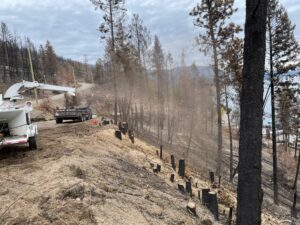
In fire-prone regions, trees deserve a different lens. FireSmart Tree Services focus on ladder fuels and defensible space. Pruning raises the canopy to reduce ignition from ground fire, and thinning crowns prevents fire from jumping tree to tree. The goal is a well-spaced arrangement with separation between the ground layer, shrubs, and the first live branches on trees.
I worked a hillside property where junipers brushed the deck and live oaks grew in clumps. We removed the junipers near structures, pruned the oaks to lift live branches 6 to 10 feet off grade depending on slope and understory, and thinned clumps so individual crowns did not touch. We chipped debris on site, but not under the drip line, and avoided stacking firewood near the home. The owner later told me a small brush fire moved through without touching the house.
Good fire work respects tree health. You do not strip a pine bare. You lift carefully so the trunk does not sunburn and you maintain interior needles where possible. Mulch helps conserve moisture and suppress weeds, but keep it a few inches away from the trunk and avoid deep bark mulch against foundations.
Aftercare, soil, and watering that make pruning count
Pruning is not a stand-alone act. Trees respond through roots and leaves, and the soil frames that response. After a significant pruning, water management matters. Deep, infrequent watering, delivered to the critical root zone at the soil surface, supports new growth and wound closure. A good rule is one inch per week during dry spells, adjusted for species and soil. Install or refresh a 2 to 4 inch layer of wood chip mulch, not piled against the trunk, to moderate temperature and moisture.
Soils in urban sites often compact to the point where water sheets off and oxygen levels drop. Air spade decompaction and organic amendments can change a tree’s trajectory more than another round of thinning. Nutrient testing avoids guesswork. I have seen more harm from blind fertilization than from any other well-intentioned act. A slow-release, low-salt product applied at the right rate based on a soil test can help; dumping high-nitrogen fertilizer into dry soil cooks fine roots.
Wound dressings rarely help. Paints and sealants trap moisture and can slow callus formation. The main exceptions are disease-specific cases such as oak wilt regions where paint on fresh cuts during high-risk months is a barrier against vectors. Here again, local guidance and a Certified Arborist Consultation matter.
Signs of poor structure you can spot from the ground
You do not need to climb to notice trouble. A quick scan reveals patterns that warrant attention.
- Codominant stems with a tight V and included bark, often with a crack line visible below the union.
- Large, long limbs that extend far beyond the canopy with no upward lateral to reduce to, especially over roofs or drives.
- Repeated deadwood in the upper crown, which can indicate root issues, compaction, or over thinning.
- Sprays of epicormic shoots along the trunk or on large limbs, a sign of previous topping, stress, or both.
- Fungal conks or oozing at the base or along major limbs, which often signal internal decay.
A Dangerous Tree Assessment and Removal plan may follow from such findings, or you may simply schedule structural pruning to get ahead of potential failures.
Working around utilities, hardscape, and neighbors
Street trees and backyard giants do not grow in isolation. Pruning for clearance near service drops and secondary lines is a job for qualified professionals with appropriate coordination. Never attempt to prune within reach of a line. Most utilities will handle high voltage lines, and arborists can work near service drops with safe practices.
Clearance over roofs and around chimneys balances building protection with tree health. Leave enough foliage on reduced limbs to maintain energy and avoid bark scorch from sudden sun exposure. Where roots lift sidewalks, root pruning can buy time if done thoughtfully, but it is risky. Removing more than a quarter to a third of the root mass or cutting a major buttress root can destabilize a tree. In many municipalities, a permit is required. A combination of sidewalk ramping, flexible surfaces like decomposed granite paths, and selective tree removal with replanting may be safer than aggressive root cuts.
Neighbors add another dimension. Branches that cross property lines can create conflict. Laws vary, but best practice is conversation before action. Invite the neighbor to a walk-through with your arborist. A written plan that addresses both properties turns contention into cooperation.
Choosing help you can trust
Tree work occupies a gray zone for many homeowners. Trucks and saws look similar whether you hire skill or bluster. Look for ISA Certified Arborists, proof of insurance, and references. Ask to see previous work, especially restorations rather than removals only. A good provider talks in specifics. They will point to branch collars and discuss reduction ratios, not just promise to “thin it out.”
If you call for a Certified Arborist Consultation, expect a visual inspection, a discussion of goals, and a clear scope with timing and pricing. For large or complex jobs, especially where defects or targets elevate risk, get two opinions. Clarity on whether the work involves Tree Pruning & Crown Shaping, Tree Cable and Bracing, or moves into Dangerous Tree Assessment and Removal keeps everyone honest and aligns expectations.
When the job wraps, the canopy should look like it grew that way, not like a buzz cut. The ground should show minimal compaction, the understory should be intact, and debris should be removed or chipped neatly unless you request mulch.
A yard of case notes
A mature sugar maple straddled a driveway, 26 inches at breast height, codominant leaders with included bark. The owner loved the shade. We reduced both leaders by 10 to 15 percent using reduction cuts to strong laterals, installed a dynamic cable 20 feet above the union, and added a single brace rod through the lower split. Soil was compacted from years of parking. We air-spaded the root zone and added mulch. Three years later, inspections showed good wound closure, reduced end weight, and no progression of the crack. The owner still parks in the shade without dreading wind advisories.
A row of ornamental pears over a restaurant patio had been topped every other year by a landscape crew. The limbs threw weak shoots, dropped them on diners during summer storms, and looked ragged by fall. We rebuilt the structure by selecting a new leader on each tree, reducing competing sprouts, and committing to staged pruning for three years. Cables secured the worst offenders. The owner accepted a slightly taller profile in exchange for fewer breaks. The complaint log emptied.
On a foothill property with seasonal fire risk, we combined FireSmart Tree Services with aesthetic goals. Valley oaks were thinned to reduce crown contact, live branches raised to 8 feet near structures, and junipers within 10 feet of the home were removed. Oaks received only reduction and deadwood removal. We created a chipped mulch bed 3 to 4 inches deep across the drip lines, kept off trunks and away from the house, and set a watering plan for drought weeks. A small grass fire tested the work the following summer. It burned through the understory without reaching the canopies or the deck.
Budget, planning, and the patience that pays off
Good pruning is not a one-time event. Think in cycles of three to five years for mature trees, and annual light work for young ones. A budget that covers a yearly Certified Arborist Consultation and spot work beats saving everything for a crisis. It also lets you spread costs while preserving health.
Sites evolve. A tree that fit between two small houses becomes crowded when both owners add second stories and a garage. Revisiting structure in light of new loads, shadows, and targets is part of stewardship. If an aging poplar starts shedding large limbs, do not pour money into endless reductions. Price the arc of the next decade. Sometimes removal plus replanting of diverse species with better site fit delivers the shade, privacy, and safety you want.
Crown shaping is as much about what you leave as what you take. It rewards patience and close looking. Five minutes spent studying the way a branch meets the trunk, the way the trunk tapers, and how light falls through the canopy saves hours of regret. The art is modest. The trees do most of the work if you let them.
Ace Tree Services Ltd.
Name: Ace Tree Services Ltd.Address: 4656 Wallace Hill Road, Kelowna, BC
Postal code: V1W 4C2
Phone: 250-212-9593
Website: https://acetree.ca/
Hours:
Monday: 7:00 AM - 5:00 PM
Tuesday: 7:00 AM - 5:00 PM
Wednesday: 7:00 AM - 5:00 PM
Thursday: 7:00 AM - 5:00 PM
Friday: 7:00 AM - 5:00 PM
Saturday: 7:00 AM - 5:00 PM
Sunday: Closed
Open-location code (plus code): RHF8+8G Kelowna, British Columbia, Canada
Map/listing URL: https://www.google.com/maps/place/Ace+Tree+Services+Ltd./@49.8232606,-119.4337283,659m/data=!3m2!1e3!4b1!4m6!3m5!1s0x537d8b1d074815c5:0x450b88afa7a41435!8m2!3d49.8232606!4d-119.4337283!16s%2Fg%2F11ydkpnh22
Embed iframe:
"@context": "https://schema.org", "@type": "HomeAndConstructionBusiness", "name": "Ace Tree Services Ltd.", "url": "https://acetree.ca/", "telephone": "250-212-9593", "address": "@type": "PostalAddress", "streetAddress": "4656 Wallace Hill Road", "addressLocality": "Kelowna", "addressRegion": "BC", "addressCountry": "CA" , "openingHoursSpecification": [ "@type": "OpeningHoursSpecification", "dayOfWeek": "https://schema.org/Monday", "opens": "07:00", "closes": "17:00" , "@type": "OpeningHoursSpecification", "dayOfWeek": "https://schema.org/Tuesday", "opens": "07:00", "closes": "17:00" , "@type": "OpeningHoursSpecification", "dayOfWeek": "https://schema.org/Wednesday", "opens": "07:00", "closes": "17:00" , "@type": "OpeningHoursSpecification", "dayOfWeek": "https://schema.org/Thursday", "opens": "07:00", "closes": "17:00" , "@type": "OpeningHoursSpecification", "dayOfWeek": "https://schema.org/Friday", "opens": "07:00", "closes": "17:00" ], "geo": "@type": "GeoCoordinates", "latitude": 49.8232606, "longitude": -119.4337283 , "hasMap": "https://www.google.com/maps/place/Ace+Tree+Services+Ltd./@49.8232606,-119.4337283,659m/data=!3m2!1e3!4b1!4m6!3m5!1s0x537d8b1d074815c5:0x450b88afa7a41435!8m2!3d49.8232606!4d-119.4337283!16s%2Fg%2F11ydkpnh22"
Ace Tree Services Ltd. provides professional tree removal, pruning, stump grinding, emergency response, and arborist consultations for properties in Kelowna and across the Okanagan Valley.
The company works with homes, commercial properties, and municipal settings where tree work needs to be planned carefully around buildings, fences, driveways, landscaping, and other site constraints.
Based in Kelowna, the team is positioned to help nearby neighbourhoods and surrounding Okanagan communities with routine tree care and time-sensitive storm cleanup.
Customers looking for careful tree work often want a crew with certified arborist training, insurance, and a methodical approach to higher-risk removals.
Services also include dangerous tree assessment, cabling and bracing, and wildfire risk reduction tree work for properties that need longer-term planning.
To request a quote or discuss tree care options, call 250-212-9593 or visit https://acetree.ca/.
A public map listing is available to help customers confirm the business location and get directions before a site visit or estimate.
For Kelowna property owners who need pruning, removals, or emergency tree help, a local tree service can make it easier to schedule site-specific recommendations and cleanup.
Popular Questions About Ace Tree Services Ltd.
What services does Ace Tree Services Ltd. provide?Ace Tree Services Ltd. lists tree removal, stump removal and grinding, tree pruning and crown shaping, emergency tree service, arborist consultation, dangerous tree assessment and removal, cabling and bracing, and wildfire risk reduction tree work.
Who does Ace Tree Services Ltd. serve?
The company describes its work as serving homes, businesses, and municipalities in Kelowna and across the Okanagan Valley.
Is emergency tree help available?
Yes. Emergency service is listed for downed or uprooted trees, dangerous tree assessment, stabilization work, and branch cleanup. If a tree is near power lines, the safest first step is to stay clear and contact the utility provider before any tree work begins.
Do I always need a permit to remove a tree?
Not always. Permit requirements can depend on where the tree is located and whether it is near a creek, lake, steep slope, or another protected area. It is best to check local rules for the specific property before removal work starts.
How deep does stump grinding usually go?
Standard stump grinding is typically described as going about 6 to 12 inches below ground level, which is often enough for grass or surface landscaping. Deeper grinding may be possible when site plans call for it.
How much of a tree can be safely removed at one time?
That depends on the species, age, health, and structure of the tree. In practice, good pruning is usually about removing the right limbs for health, clearance, and structure rather than chasing a fixed percentage.
What are common signs that a tree may be dangerous?
Large dead limbs, visible cracks, a new lean, root damage, canopy dieback, or storm-related damage can all be warning signs. Trees near structures deserve extra attention when any of those issues appear.
What is cabling and bracing in tree care?
Cabling and bracing are support systems used to reduce the risk of failure in trees with structural weaknesses that may still be worth preserving. They are generally used to add support, not to replace good assessment and ongoing maintenance.
How do I contact Ace Tree Services Ltd.?
Call 250-212-9593.Website: https://acetree.ca/.
Landmarks Near Kelowna, BC
Downtown KelownaThe downtown core is a practical reference point for lakefront neighbourhoods, mixed-use streets, and central residential properties. If your property is near downtown, tree pruning, removals, and cleanup can be planned around tighter access and nearby structures.
Knox Mountain Park
This well-known park north of downtown is a recognizable landmark for nearby homes and hillside properties. If you are close to this area, ask about tree assessment, trimming, or removal work suited to sloped sites.
Mission Creek Greenway
The greenway runs through several parts of Kelowna and is a useful landmark for nearby residential areas. If your property borders or sits near this corridor, site-specific tree planning is especially important.
Pandosy Village
Pandosy is one of Kelowna’s most recognizable neighbourhoods and a common reference point for south-central properties. If you are nearby, request help for pruning, removals, or storm cleanup around homes and small commercial sites.
Rutland
Rutland is a major east Kelowna neighbourhood with a mix of residential and local commercial properties. If you are located in or near Rutland, tree work can be scheduled for both routine maintenance and urgent situations.
Landmark District
This central business-focused area is a practical landmark for offices, service properties, and nearby residential streets. If your site is near the district, ask about careful tree work around parking, access lanes, and built-up lots.
Kelowna’s North End
The North End sits on the edge of downtown and is a useful reference for nearby homes, industrial sites, and commercial properties. If you are in this part of the city, request tree care based on the layout and constraints of the lot.
Airport District
The Airport District is a recognizable north Kelowna reference point for surrounding properties and access routes. If you are in this area, ask about tree services for residential acreage, commercial sites, or roadside cleanup needs.
Glenmore & Dilworth
These established Kelowna neighbourhoods are useful landmarks for central and north-central service calls. If your property is nearby, pruning and removal work can be tailored to mature trees and established landscapes.
Highway 97 Corridor
Highway 97 is one of the city’s main travel routes and a common way to describe location within Kelowna. If your home or property is just off the corridor, a clear landmark reference can help speed up quote scheduling and site planning.