Comprehensive Tree Removal Services and Debris Hauling
Trees make neighborhoods feel established and calm, yet they also carry weight and leverage that can turn a routine project into a high‑risk operation. A mature hardwood can push thirty thousand pounds of mass and store the energy of a loaded spring. When decay, storm damage, or construction conflicts enter the picture, the right plan and the right crew matter more than any single tool. Comprehensive Tree Removal Services address more than just sawing wood. They start with expert diagnosis, account for liability and infrastructure, and finish with clean ground and a clear path for what comes next.
What “comprehensive” really covers
A complete service package connects arboriculture to logistics. On the front end, a Certified Arborist Consultation makes sure the decision to remove, prune, or brace has a sound basis. On the back end, debris handling, recycling, and site restoration leave the property in better condition than before work began. In between, the crew chooses techniques that balance time, cost, safety, and the tree’s biology.
The work often spans these elements: Tree Removal Services sized to the site, Stump Removal & Grinding, Tree Pruning & Crown Shaping for trees that should stay, Tree Cable and Bracing when structure can be improved without removal, Dangerous Tree Assessment and Removal for high‑risk situations, Emergency Tree Services during storms or failures, and FireSmart Tree Services in regions where fuel management reduces wildfire exposure. A provider who treats these as an integrated toolkit can guide you to the least intrusive, most cost‑effective option rather than defaulting to removal.
Risk, liability, and why method beats muscle
I have stood on lawns where a nickel‑wide crack at the base of a cottonwood meant 10 tons of urgency, and inside tight courtyards where a 40‑foot spruce had to disappear without brushing a pane of glass. The same chainsaw handled both jobs, but the methods were worlds apart. The best crews see the landscape as a system. They model the load paths of limbs, tie‑in positions for climbers, swing radii for cranes, and fall zones for chunks. They check soil saturation and wind, then set ground controls and communication channels. When the day goes well, it looks calm. That is not luck. It is built on training, pre‑planning, and redundant safety.
A good operator also respects boundaries you cannot see. Underground utilities sit closer to trunks than most homeowners realize. Private sewer laterals drift under front lawns. Irrigation lines wander. A comprehensive company calls utility locates, probes carefully, and adjusts stump grinding depth so you do not trade one problem for another.
The first conversation: diagnosis before decisions
A Certified Arborist Consultation does more than confirm a hunch. It starts with targets, not just the tree. What could be hit if something fails? That risk sets urgency. Next comes a visual assessment of crown density, dieback, fungal bodies at the base, seams, and bark characteristics. A rubber mallet or resistance drill may test for hollows. Root flare exposure or heaving soil can show instability. On client requests that warrant it, an aerial inspection catches defects hidden from the ground.
The arborist pairs those findings with history, soil, species traits, and goals. A leaning red oak that has grown on a slope for 40 years may be stable and just needs Tree Pruning & Crown Shaping to reduce sail. A silver maple with co‑dominant stems, embedded bark, and fruiting bodies could respond to Tree Cable and Bracing combined with selective pruning, buying years while preserving shade. If targets are high and defects are advanced, Dangerous Tree Assessment and Removal becomes the responsible answer.
What a complete workflow looks like
Homeowners often only see the visible parts, the bucket moving or the chipper running. The best outcomes follow a repeatable sequence that scales from small yards to multi‑acre properties.
- Site evaluation and plan: confirm access, utilities, and fall zones; identify fragile surfaces and set protection; choose method and equipment based on tree size, structure, and targets.
- Rigging and access setup: place mats, cones, and signage; set climbing lines or bucket reach; lay out blocks, slings, and lowering devices; confirm radio or hand signal protocols.
- Sectional removal or felling: execute planned cuts, control loads with ropes or cranes, and monitor hinge wood and swing; adapt in real time to internal decay or fiber characteristics.
- Debris handling and transport: chip brush on site or haul for compost, log heavy wood for mills or firewood, sort metal from embedded hardware, and keep streets and neighbors safe during truck movements.
- Final cleanup and restoration: grind stumps to specified depth, backfill with chips or soil as requested, rake and blow fine debris, inspect irrigation for nicks, and walk the site with the client.
That list fits a normal day. Storm damage or confined spaces add new steps, but the bones remain the same.
Choosing the right technique for removal
There is no universal method. The choice lives at the intersection of structure, space, and budget.
Conventional felling makes sense on open ground with a straight trunk and predictable lean. You control the hinge with precise face and back cuts, use wedges to counter back‑lean, and spotters keep the area clear. The cost is usually lowest, the risk manageable, and cleanup straightforward. Urban settings rarely allow it.
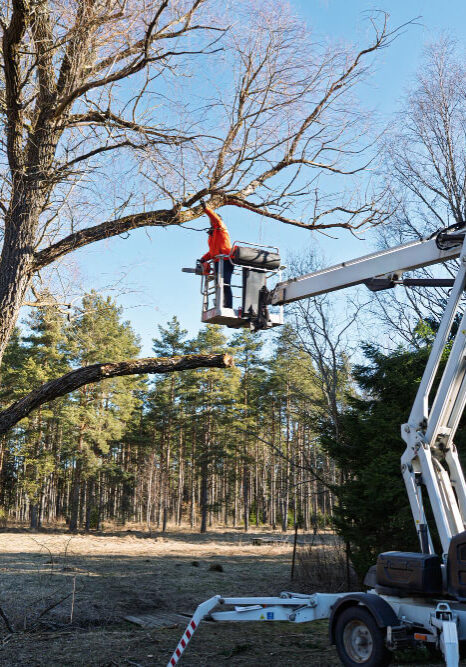
Sectional dismantling is the bread and butter for tight sites. A climber or bucket operator removes the crown from the top down, lowering pieces with friction devices that bleed energy so chunks land where you want them. Counterweight techniques help when the tie‑in point is below the piece being removed. This approach reduces collateral damage, but it adds labor.
Cranes shine when the tree is too compromised to trust traditional rigging or when heavy wood must clear obstacles like glass canopies or pool enclosures. Flying 800‑pound picks over roofs looks dramatic, yet it often reduces overall site risk. The operator and climber coordinate lift angles and load balance. A 70‑ton crane with enough reach can turn a two‑day dismantle into a half day with fewer roof touches.
Anecdotally, one of our trickiest days involved a cottonwood over a slate roof with no bucket access and barely a driveway for outriggers. Cribbing with three layers of hardwood mats and a 90‑foot boom kept our picks within the crane’s sweet spot. The homeowner expected cracked tiles. We did not break one. Preparation and the right partner made that possible.
Stump Removal & Grinding with foresight
Tree removal is not finished until the stump is addressed. Grinding to 8 to 12 inches below grade meets many landscaping needs, but deeper passes, 16 to 20 inches, insert flexibility for replanting or patio footings. You protect nearby roots of retained trees by setting limits and angles for the grinder. In clay soils, grinding generates a lot of chips mixed with soil. Those chips decompose and settle over months. If a level lawn is the priority, plan on hauling excess chips and bringing in loam.
Metal in stumps complicates work. Hidden lag bolts, fence wire, or nails can shatter teeth, slow production, and increase cost. A detector sweep and honest conversation about price adjustments keep surprises to a minimum. When utilities are close, hand digging and careful probing define safe zones before the wheel spins.
Tree Pruning & Crown Shaping, the often better first move
Removing a tree takes five minutes with a saw and years to replace the shade. When biology and safety allow it, thoughtful pruning solves problems without losing the asset. Reduction cuts that shift sail lower in the crown can reduce wind loading by 15 to 25 percent with a light hand that preserves natural form. Structural pruning on young trees sets good branch spacing, which saves money decades later. Crown cleaning, the removal of dead, diseased, or rubbing wood, improves health and reduces storm litter.
Crown shaping is less about forcing a manicured silhouette and more about proportion and clearance. You can lift a crown for sidewalk space, ease roof interference, or improve sightlines without gutting the canopy. Over‑thinning, especially in species like live oak or maple, invites sunscald and epicormic sprouting. A certified arborist uses species‑specific guidelines rather than one‑size rules.
Tree Cable and Bracing for imperfect architecture
Some trees grow defects worth managing. Co‑dominant stems with narrow crotch angles trap bark and weaken attachment. Older ornamentals split under snow load. Cables and braces can share loads and limit movement. Properly installed dynamic or static cables sit high in the canopy, typically at two‑thirds of the height of the union. Through‑bolts, washers, and spacers protect cambium and spread force. Hardware choices depend on species, expected loads, and how much movement you want to allow. Cables work best paired with selective pruning to reduce lever arms. They also require inspection. A good company logs hardware installs and revisits on a schedule.
Dangerous Tree Assessment and Removal when failure is near
I have tapped trunks that sounded like drums, only to find a paper‑thin shell around a column of rot. Trees like that can look green and healthy from the curb. Indicators include fungal conks at the base, longitudinal cracks, heavy lean with recent soil heave, or sudden canopy dieback. When targets are high, the judgment tilts toward removal.
Technique changes when wood will not hold rigging. You may need a crane for top picks, or you may set independent anchor points in adjacent trees or portable anchors. Cuts become smaller, swings shorter, and escape routes clearer. Sometimes, felling across a lawn and accepting turf repairs is safer than lowering every limb near power service lines. Dangerous trees ask for humility and backups, not heroics.
Emergency Tree Services, when schedules go out the window
Storms compress risk into hours. Splits open, roots lever out on saturated soil, and wind throws pieces into unpredictable locations. Emergency Tree Services aim first at life safety and utilities, then at property preservation. That triage might mean stabilizing with temporary guy lines, relieving weight from a compromised stem, or cutting your way to a safe egress. Night work happens, but lights can flatten depth perception and hide hazards. Crews that train for emergencies stage tarps, plywood, rope bags, and oil‑dry in their trucks so the first hour counts.
Pricing in emergencies reflects unknowns and overtime hours. A transparent company explains the premium beforehand, even if the exact total depends on site conditions. Photographs and notes document decisions for insurance.
FireSmart Tree Services and living in fire country
Where wildfire is part of the climate, fuel management is a design choice, not an afterthought. FireSmart Tree Services look at vertical and horizontal continuity. Ladder fuels, the low branches and shrubs that let fire climb, need spacing and breakpoints. Pruning lower limbs to raise crown base height, spacing shrubs, and choosing species with less resin or fine litter all reduce ignition potential.
On one hillside project outside a wildland urban interface, we reduced ladder fuels, thinned crowded saplings, and created 10 feet of vertical clearance under mature pines. We chipped on site and mulched with a thin, discontinuous layer rather than deep mats that smolder. The owner accepted a more natural, less plush aesthetic in exchange for a measurable drop in risk. That trade felt right for the setting.
Debris hauling, recycling, and what happens after the last cut
Debris is where projects either end well or drag on for days. A well‑run crew treats hauling as integral, not an afterthought. Brush runs through a chipper sized to the job. Chips can be left on site as paths or mulch if the client wants them, or hauled to compost facilities. Bigger logs have value streams. Some go to small mills for slab lumber. Straight, clean sections of oak, walnut, or ash can turn into tables or mantels. Urban wood programs in some regions help move material to artisans.
Heavy loads and narrow streets require permits and spotters. Nothing sours a job like a gouged driveway or broken mailbox from a quick turn. Ground mats spread weight. Tailgates close before the truck moves. Sweepers and blowers chase fines from sidewalks and gutters. On HOA properties, crews plan chipper placement to keep noise away from bedrooms when possible.
Permits, utilities, and neighborhood diplomacy
Municipal rules vary. Some cities require permits or replacement plantings for removals beyond a certain diameter at breast height. Heritage trees receive extra scrutiny. If the tree touches the right of way, public works might need a traffic control plan for a half‑day lane closure. A comprehensive company handles the paperwork and explains timelines so you can schedule other trades accordingly.
Utilities add another layer. Service drops for electricity pass through crowns more often than they should. Utility companies must handle line drops or coverings. Communication with neighbors matters too, especially if equipment must stage on a shared driveway. A handwritten note with dates and a contact number buys a lot of goodwill.
What to expect on cost
Prices swing with location, access, risk, and wood volume. As a rough orientation, a straightforward removal of a mid‑sized ornamental in open lawn might fall in the 600 to 1,200 dollar range. A large, complex removal with crane support and tight rigging can reach 3,000 to 8,000 dollars, sometimes more for specialty lifts or all‑night emergency work. Stump grinding often bills separately, 8 to 12 dollars per inch of stump diameter measured at grade, with minimums to cover mobilization. Cable installs, depending on hardware and height, can start around a few hundred dollars and rise with the number of anchors and access complexity.
Clear proposals spell out inclusions. Are permits included, is haul‑off complete or partial, how deep is the stump grind, and who handles irrigation repairs if needed? Transparent scope keeps the final invoice close to the estimate.
A short checklist for hiring well
- Ask for a current certificate of insurance, including workers’ compensation and liability, issued to you directly by the insurer.
- Verify credentials for Certified Arborist Consultation, and ask who will be on site, not just who sold the job.
- Request a written scope that identifies cleanup standards, stump depth, and disposal or reuse of wood.
- Look for safety culture cues, like helmets, eyewear, and clear communication on site visits.
- Weigh references and photos that match your site constraints rather than generic portfolios.
I have walked away from jobs where homeowners had cheaper bids but no proof of insurance. The savings are not savings if a climber gets hurt on your property or a falling limb hits a car. Competence and coverage protect everyone.
Property protection and leaving a site spotless
A seasoned crew thinks like a caretaker. Before the first cut, they roll out mats to protect turf and pavers. They pad railings and wrap downspouts. They lift garden art and set it out of harm’s way. When logs cross lawns, they lay skids to spread load and prevent ruts. At the end, the best part is how ordinary the yard looks. You should walk around and find no hidden pockets of chips behind shrubs, no broken drip lines, no stray hardware. On tight sites, impeccable cleanup https://edwinbqzs079.raidersfanteamshop.com/tree-cable-and-bracing-to-protect-high-value-trees-1 is not a luxury. It is part of the craft.
Real scenarios, real choices
A small urban backyard with a declining birch boxed in by fences: bucket access was impossible. We climbed with light rigging, lowered short pieces to land on a plywood runway, hand‑carried brush to the alley, and parked the chipper on the street during off‑peak hours. The neighbor’s roses stayed intact because we took an extra 30 minutes to tarp them and set a guard. The job finished on time because the plan matched the space.
A storm‑snapped pine draped over a garage with the back half still standing: the split ran well into the stem. We set a temporary guy to stabilize, relieved weight from the suspended side first, then employed a crane to take the standing half in controlled picks. Insurance had clear photos of each stage, which sped their claims process. The homeowner slept better the next night because the garage was covered and the yard was safe.
Aftercare and planning what comes next
Removal is often the right call, but it leaves a gap. Soil biology benefits from replacing what the tree once provided. Mulch the area thinly, water on a smart schedule, and consider replanting with species suited to the site. Where pests like emerald ash borer or sudden oak death are present, follow disposal guidelines so infested wood does not spread the problem. When replanting, match mature size to the space. A small terrace wants a serviceberry, not a future giant. Structural pruning during the first five years costs little and sets a tree up for a long, low‑maintenance life.
Where pruning, bracing, and removal meet FireSmart thinking
On properties with fire risk, tree work plugs into a bigger picture. Removing a dense juniper close to siding might matter more than taking down a distant oak. Crown lifting and spacing trees so canopies do not touch can slow fire movement. Grinding out an old stump near the deck and replacing it with a stone seating area reduces fuel and adds function. This is where FireSmart Tree Services connect with design. You are not just taking things away. You are shaping a landscape that performs under stress.
A brief word on etiquette and neighbors
Chainsaws and chippers make noise. Good crews keep it within legal hours, but a little courtesy goes far. A note the day before, a quick chat the morning of, and cones that keep driveways clear can turn a potential headache into a non‑event. I have seen entire cul‑de‑sacs bring out lawn chairs to watch a crane day, then applaud at the last pick. People respond well when workers look professional and the site stays tidy.
The value of an arborist mindset
Even when the outcome is removal, an arborist’s lens changes the process. It asks first whether the tree can be preserved through Tree Pruning & Crown Shaping, Tree Cable and Bracing, or lighter‑touch interventions. It evaluates failure modes before choosing tools. It weighs targets and timing. And when the saw does start, it coordinates the effort from the first notch to the last handful of sawdust in the gutter.
Comprehensive Tree Removal Services are not only about getting a trunk on the ground. They are about stewardship of risk, property, and the living system you keep around your home. When you hire for judgment as much as horsepower, you get safer outcomes, better cleanup, and a landscape that keeps working for you long after the trucks pull away.
Final tips before you schedule
- Time removal outside nesting seasons when possible, and ask about wildlife checks if cavities exist.
- If you plan to replant, mark irrigation and plan grinding depth and backfill for the new species.
- Clarify wood disposition, whether you want chips left, logs cut to fireplace lengths, or a clean haul‑off.
- Reserve parking for trucks and chipper placement. A few cones the night before can save an hour of shuffling.
- Walk the site with the crew lead at the start and finish. Shared expectations make for smooth projects.
From the arborist’s first look to the last sweep of the blower, the craft is about respect. Respect for safety, for your property, and for the trees that shape our spaces. Whether you need Emergency Tree Services after a storm, careful Dangerous Tree Assessment and Removal near a roofline, or a routine prune, choose partners who carry that respect into every cut and every loaded truck.
Ace Tree Services Ltd.
Name: Ace Tree Services Ltd.Address: 4656 Wallace Hill Road, Kelowna, BC
Postal code: V1W 4C2
Phone: 250-212-9593
Website: https://acetree.ca/
Hours:
Monday: 7:00 AM - 5:00 PM
Tuesday: 7:00 AM - 5:00 PM
Wednesday: 7:00 AM - 5:00 PM
Thursday: 7:00 AM - 5:00 PM
Friday: 7:00 AM - 5:00 PM
Saturday: 7:00 AM - 5:00 PM
Sunday: Closed
Open-location code (plus code): RHF8+8G Kelowna, British Columbia, Canada
Map/listing URL: https://www.google.com/maps/place/Ace+Tree+Services+Ltd./@49.8232606,-119.4337283,659m/data=!3m2!1e3!4b1!4m6!3m5!1s0x537d8b1d074815c5:0x450b88afa7a41435!8m2!3d49.8232606!4d-119.4337283!16s%2Fg%2F11ydkpnh22
Embed iframe:
"@context": "https://schema.org", "@type": "HomeAndConstructionBusiness", "name": "Ace Tree Services Ltd.", "url": "https://acetree.ca/", "telephone": "250-212-9593", "address": "@type": "PostalAddress", "streetAddress": "4656 Wallace Hill Road", "addressLocality": "Kelowna", "addressRegion": "BC", "addressCountry": "CA" , "openingHoursSpecification": [ "@type": "OpeningHoursSpecification", "dayOfWeek": "https://schema.org/Monday", "opens": "07:00", "closes": "17:00" , "@type": "OpeningHoursSpecification", "dayOfWeek": "https://schema.org/Tuesday", "opens": "07:00", "closes": "17:00" , "@type": "OpeningHoursSpecification", "dayOfWeek": "https://schema.org/Wednesday", "opens": "07:00", "closes": "17:00" , "@type": "OpeningHoursSpecification", "dayOfWeek": "https://schema.org/Thursday", "opens": "07:00", "closes": "17:00" , "@type": "OpeningHoursSpecification", "dayOfWeek": "https://schema.org/Friday", "opens": "07:00", "closes": "17:00" ], "geo": "@type": "GeoCoordinates", "latitude": 49.8232606, "longitude": -119.4337283 , "hasMap": "https://www.google.com/maps/place/Ace+Tree+Services+Ltd./@49.8232606,-119.4337283,659m/data=!3m2!1e3!4b1!4m6!3m5!1s0x537d8b1d074815c5:0x450b88afa7a41435!8m2!3d49.8232606!4d-119.4337283!16s%2Fg%2F11ydkpnh22"
Ace Tree Services Ltd. provides professional tree removal, pruning, stump grinding, emergency response, and arborist consultations for properties in Kelowna and across the Okanagan Valley.
The company works with homes, commercial properties, and municipal settings where tree work needs to be planned carefully around buildings, fences, driveways, landscaping, and other site constraints.
Based in Kelowna, the team is positioned to help nearby neighbourhoods and surrounding Okanagan communities with routine tree care and time-sensitive storm cleanup.
Customers looking for careful tree work often want a crew with certified arborist training, insurance, and a methodical approach to higher-risk removals.
Services also include dangerous tree assessment, cabling and bracing, and wildfire risk reduction tree work for properties that need longer-term planning.
To request a quote or discuss tree care options, call 250-212-9593 or visit https://acetree.ca/.
A public map listing is available to help customers confirm the business location and get directions before a site visit or estimate.
For Kelowna property owners who need pruning, removals, or emergency tree help, a local tree service can make it easier to schedule site-specific recommendations and cleanup.
Popular Questions About Ace Tree Services Ltd.
What services does Ace Tree Services Ltd. provide?Ace Tree Services Ltd. lists tree removal, stump removal and grinding, tree pruning and crown shaping, emergency tree service, arborist consultation, dangerous tree assessment and removal, cabling and bracing, and wildfire risk reduction tree work.
Who does Ace Tree Services Ltd. serve?
The company describes its work as serving homes, businesses, and municipalities in Kelowna and across the Okanagan Valley.
Is emergency tree help available?
Yes. Emergency service is listed for downed or uprooted trees, dangerous tree assessment, stabilization work, and branch cleanup. If a tree is near power lines, the safest first step is to stay clear and contact the utility provider before any tree work begins.
Do I always need a permit to remove a tree?
Not always. Permit requirements can depend on where the tree is located and whether it is near a creek, lake, steep slope, or another protected area. It is best to check local rules for the specific property before removal work starts.
How deep does stump grinding usually go?
Standard stump grinding is typically described as going about 6 to 12 inches below ground level, which is often enough for grass or surface landscaping. Deeper grinding may be possible when site plans call for it.
How much of a tree can be safely removed at one time?
That depends on the species, age, health, and structure of the tree. In practice, good pruning is usually about removing the right limbs for health, clearance, and structure rather than chasing a fixed percentage.
What are common signs that a tree may be dangerous?
Large dead limbs, visible cracks, a new lean, root damage, canopy dieback, or storm-related damage can all be warning signs. Trees near structures deserve extra attention when any of those issues appear.
What is cabling and bracing in tree care?
Cabling and bracing are support systems used to reduce the risk of failure in trees with structural weaknesses that may still be worth preserving. They are generally used to add support, not to replace good assessment and ongoing maintenance.
How do I contact Ace Tree Services Ltd.?
Call 250-212-9593.Website: https://acetree.ca/.
Landmarks Near Kelowna, BC
Downtown KelownaThe downtown core is a practical reference point for lakefront neighbourhoods, mixed-use streets, and central residential properties. If your property is near downtown, tree pruning, removals, and cleanup can be planned around tighter access and nearby structures.
Knox Mountain Park
This well-known park north of downtown is a recognizable landmark for nearby homes and hillside properties. If you are close to this area, ask about tree assessment, trimming, or removal work suited to sloped sites.
Mission Creek Greenway
The greenway runs through several parts of Kelowna and is a useful landmark for nearby residential areas. If your property borders or sits near this corridor, site-specific tree planning is especially important.
Pandosy Village
Pandosy is one of Kelowna’s most recognizable neighbourhoods and a common reference point for south-central properties. If you are nearby, request help for pruning, removals, or storm cleanup around homes and small commercial sites.
Rutland
Rutland is a major east Kelowna neighbourhood with a mix of residential and local commercial properties. If you are located in or near Rutland, tree work can be scheduled for both routine maintenance and urgent situations.
Landmark District
This central business-focused area is a practical landmark for offices, service properties, and nearby residential streets. If your site is near the district, ask about careful tree work around parking, access lanes, and built-up lots.
Kelowna’s North End
The North End sits on the edge of downtown and is a useful reference for nearby homes, industrial sites, and commercial properties. If you are in this part of the city, request tree care based on the layout and constraints of the lot.
Airport District
The Airport District is a recognizable north Kelowna reference point for surrounding properties and access routes. If you are in this area, ask about tree services for residential acreage, commercial sites, or roadside cleanup needs.
Glenmore & Dilworth
These established Kelowna neighbourhoods are useful landmarks for central and north-central service calls. If your property is nearby, pruning and removal work can be tailored to mature trees and established landscapes.
Highway 97 Corridor
Highway 97 is one of the city’s main travel routes and a common way to describe location within Kelowna. If your home or property is just off the corridor, a clear landmark reference can help speed up quote scheduling and site planning.