Crane-Assisted Tree Removal Services for Large Trees
Removing a mature tree in a tight urban courtyard, over a slate roof, or from a steep slope can feel like defusing a bomb. There is weight, tension, decay you cannot see, and physics that do not forgive a misjudgment. A crane changes what is possible. When used by an experienced crew, it turns a risky dismantle into a controlled sequence, lifting entire sections out and setting them down exactly where a ground crew needs them. It also reduces time on site, which lowers disruption for neighbors and shortens the window in which something can go wrong.
I have spent long mornings on sidewalks before sunrise, chalking out crane pads and swing radiuses while traffic crews set cones. The calm you feel when a 10,000 pound log hovers above a chimney is not luck. It comes from planning, communication, and a clear method that starts days before the crane ever starts its engine.
Why cranes change the game for large tree removal
Traditional removals rely on climbers working the canopy, rigging pieces down to the ground using friction devices and control lines. In open yards with good drop zones, that remains efficient. In dense neighborhoods or around sensitive structures, free space is a luxury. A crane gives you a vertical exit. It lifts sections clear of roofs, fences, and glasshouses, and lands them where a chipper or sawyer can process safely.
There are other advantages that show up in the numbers. Cranes reduce the number of cuts a climber must make aloft, which means fewer moments with a running saw and less time exposed to potential kickback or bar pinch. Lifting entire stems in three or four picks instead of twenty piece rigging can trim a multi day job to a single shift. On storm losses where stems are split or barber chair risks are high, a crane can remove tension from the equation, literally, by holding weight that would otherwise bind or spring.
None of that makes crane work simple. The margin for error tightens. Load charts matter. Communication is non negotiable. And you still need an arborist’s understanding of how wood fibers fail.
When a crane is the right answer
Cranes are not a status symbol on a job site. Sometimes a tracked lift, a careful rigging plan, or selective Tree Pruning & Crown Shaping solves the real problem. A crane earns its place when it meaningfully reduces risk or time.
Here is a quick decision lens teams use before recommending crane assisted Tree Removal Services:
- The tree threatens structures on at least two sides, leaving no acceptable drop zone for rigged pieces.
- Decay, heavy lean, or storm damage makes traditional climbing and rigging unacceptably risky.
- The site is constrained by slope, pools, or delicate landscapes that make ground rigging impractical.
- Overhead utilities, public roads, or property lines limit swing and landing options for rigged limbs.
- Removing the tree without a crane would push the job beyond a safe workday or into night work.
If two or more of these are true, a crane assessment is warranted. That assessment should not be a salesperson’s glance. It should be a Certified Arborist Consultation paired with a site review from a certified crane operator or lift supervisor.
Dangerous tree assessment starts the plan
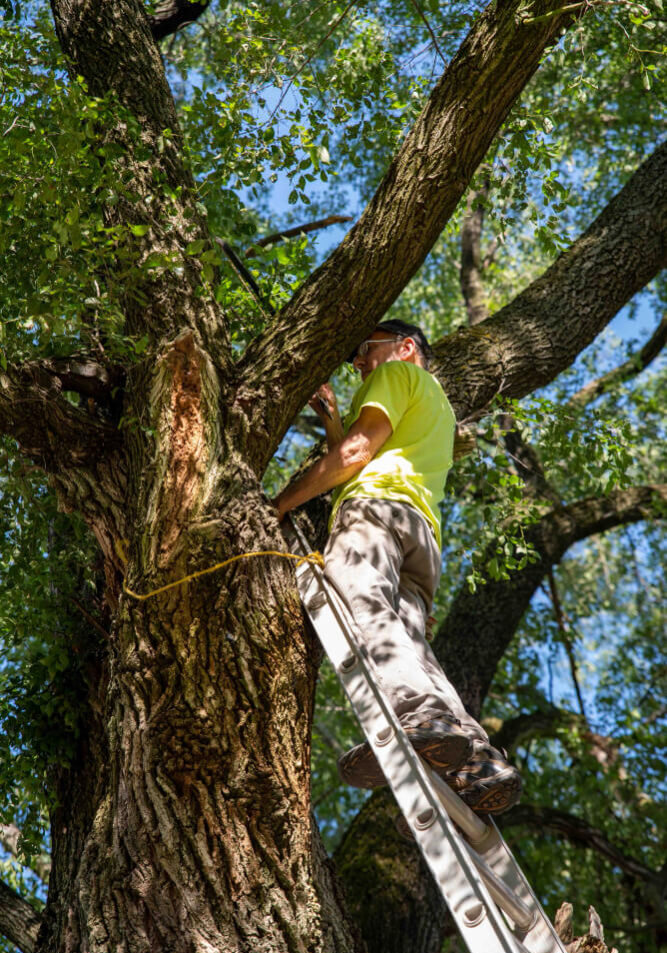
Before we talk equipment, we need to understand the wood. Dangerous Tree Assessment and Removal begins with ground level cues. A decayed buttress root, a column of conks, a long bark seam from lightning, or a hollow drum tone when you strike the trunk can change a plan. In some cases I will core sample suspect areas to gauge shell thickness, particularly on older cottonwoods and willows where heartwood can be unreliable. We examine lean, crown distribution, and wind exposure. If a codominant union failed on one side, the remaining stem often holds more tension than it appears.
From there we map hazards you cannot prune away. A glass sunroom under the dripline forces either smaller, slower rigging pieces or a vertical exit. Retaining walls, koi ponds, and septic fields influence where we can stage mats, how much outriggers can bear, and where we can land logs.
This evaluation ties directly into the crane’s role. If the stem is compromised near the base, for example, we will avoid lifting the entire trunk in one dramatic pick. Instead, we might set the climber just below the compromised zone with additional safety measures, or use a grapple saw on the crane to minimize climber exposure. The goal is not heroics, it is control.
Choosing the right crane and rigging
Cities often require compact cranes for downtown work, while suburban estates might allow full sized hydraulic cranes with 100 ton capacity. Reach matters as much as capacity. A 60 ton crane with a 130 foot boom may safely pick 2,000 to 3,500 pounds at long radius, which is plenty for many canopy sections. At tighter radiuses near the tree, that same crane may pick 8,000 pounds or more. Load charts rule the day, and we always include a safety margin rather than chasing theoretical maximums.
Rigging choices determine how stress moves into wood. A balanced lift, secured with two or three slings at calculated angles, avoids rolling a log or torquing a decayed union. For horizontal leaders, a belly sling near the center of gravity with a tag line to control swing is common. For vertical stems, we often use a double choked setup to prevent slippage, with the climber making a top cut only after the operator has taken weight and confirmed balance.
Grapple saw cranes simplify some of this, particularly on storm response where speed and reduced climbing exposure are priorities. They still require the same judgement about fiber strength and load paths, and they demand a clear no go zone beneath.
Crew roles and clean communication
The smoothest crane removals feel boring from the sidewalk. That is what you want. Each person has a role and stays within it. The operator watches the boom, the swing, and the load, speaking a shared language with the climber. The climber or cutting technician makes predictable, clean cuts and confirms balance. A lift director controls the site and traffic. Ground crew clear brush fast enough to prevent a bottleneck under the landing zone, but never rush into pinch points.
We use headsets so we do not rely on hand signals when a diesel engine and chipper drown conversation. Short, standard phrases carry far. Take the weight. A hair more. Hold. Cutting. Clear. Swinging left. Land it. Unhook. The fewer words, the fewer chances to misunderstand. No one calls out instructions while the saw is in the cut. If something feels wrong, we set the piece down and rethink it.
A day on site, step by step
Every property, tree species, and neighborhood has its quirks, but most crane assisted jobs follow a reliable arc. If you have never watched one up close, here is what to expect.
- Mobilization and setup. Traffic control sets cones. Mats go down to protect turf and distribute weight. The crane levels on outriggers, and the operator checks clearances and load charts for the planned radius.
- Pre lift briefing. The crew walks the plan, confirms hand signals or headsets, assigns zones, and rehearses emergency stops. If utilities are nearby, the utility’s clearance plan is reviewed again.
- Crown reduction and balance picks. We start by removing outer canopy sections to reduce sail and make later stem picks cleaner, often lifting large leaders directly to ground.
- Main stem removal. With the canopy gone, we lift trunk sections in measured lengths that match the crane’s radius and capacity, typically two to six feet depending on diameter and wood density.
- Ground processing and site restoration. Brush feeds the chipper, logs are bucked and stacked or loaded out, stump height is cut low if grinding is scheduled, and final raking and blow down leaves the yard ready.
On larger removals we may stop midday to re level the crane if ground compression changes outrigger height. When the last log rolls into the truck and the stump is flush cut, a separate Stump Removal & Grinding crew often follows within a day or two, especially if irrigation lines need to be located.
Costs, permits, and what affects the schedule
Cranes raise the day rate. That is unavoidable. What you gain is time certainty and lower risk. In our market, a mid sized crane and crew might price from the low thousands for a simple, short reach removal, to several times that for all day work with road closures, complex rigging, or night hours. Factors that move the number include tree size and species, decay, reach, utility clearance requirements, access for mats, and whether debris has to be hand carried from a backyard.
Municipal permits vary. Some cities require a street occupancy permit for any crane that extends into the right of way. If the tree sits on a shared boundary, you may need neighbor consent. For heritage species or diameter thresholds, the city may require a permit and replacement planting plan. A Certified Arborist Consultation helps navigate this early to prevent day of surprises.
Scheduling follows equipment availability and weather. We do not set outriggers on saturated lawns without mats, and we do not swing steel in lightning or high wind. If your deadline is fixed, we build contingency days around it.
Working near utilities and structures
Cranes solve proximity problems, but they add their own. Overhead conductors demand minimum approach distances that change with voltage. Even without touching a line, induced current can arc. If the work zone is within that envelope, we coordinate with the utility for line covers, de energized spans, or a live line watch. Underground, we call before we dig and before we set outriggers. A buried gas line beneath an outrigger pad is a bad surprise.
Structures like glass roofs, masonry chimneys, or old stucco deserve attention. We protect them with plywood shields and load rated blankets where landing zones or tag lines come close. If the only setup area is a driveway, we use mats to distribute point loads and check the concrete’s thickness to avoid cracking.
Storm damage and Emergency Tree Services
When wind or snow breaks a tree, fibers fail unpredictably. Hanging leaders that look calm can be spring loaded. In those situations, Emergency Tree Services with crane support keep responders and homeowners out of the bite. We often pair the crane with a grapple saw to remove twisted, split wood without sending a climber into a hazard. On ice storms, timing can matter more than precision. We stabilize first, then return for full removal or repair once streets reopen and power crews have done their part.
Not every storm job calls for wholesale removal. A damaged crown might be saved with judicious pruning and Tree Cable and Bracing to stabilize unions. The deciding factor is always structural integrity, not sentiment. If decay or cracks run deep into the trunk, taking the tree down before the next wind is the honest advice.
Alternatives when removal feels premature
Sometimes the tree is simply too big for its setting, but not yet a hazard. Before reaching for a crane, consider whether Tree Pruning & Crown Shaping can reduce sail and weight at the tips while preserving form. On healthy oaks and maples, thinning and selective reduction can lower failure risk meaningfully, especially when combined with cabling to support long, overextended leaders.
In wildfire interface zones, FireSmart Tree Services can change the calculus for removal. Creating defensible space, lifting live crowns, removing ladder fuels, and managing ground debris often lowers risk without clear cutting. In these landscapes, we weigh the benefits of shade and soil stability against ember shower exposure. If a tree sits closer than guidelines allow, or has resinous bark and low limbs near structures, removal might still be the right call. The point is to make the decision on evidence, not fear.
What happens after the tree is gone
A job is not finished at the last pick. If you leave a tall stump, it will become tomorrow’s trip hazard or the homeowner’s regret. We usually cut flush if a grinder is scheduled. Stump Removal & Grinding reaches 6 to 12 inches below grade in most cases, deeper if a replant is planned. On older stumps of cedar or eucalyptus, multiple passes may be needed, and we often cut and split surface roots so the grinder does not chase them for long distances through lawns.
Debris management matters to neighbors. We chip on site into trucks, but on narrow streets we stage brush to avoid blocking mailboxes or driveways. Log sections can be milled, stacked for firewood, or hauled to green waste. For clients who want to keep wood, we cut to uniform lengths and leave it in a neat cord, not a random pile the next wind will scatter.
Restoration is the last impression. Rake thoroughly, blow off patios, close gates, and walk the site with the client. If sprinkler heads or garden lights were protected and then moved, return them to their exact spots. If mats left slight turf impressions, a light roll often flattens them.
Safety and insurance, the quiet foundations
Cranes compress risk into heavy moments. Any company offering crane assisted Tree Removal Services should carry proper general liability, vehicle coverage for the crane and chip trucks, and workers’ compensation that actually covers tree work. Ask to see certificates. If a subcontracted crane is used, make sure your contract recognizes who is responsible for what. A detailed job hazard analysis on paper takes fifteen minutes and clarifies questions you do not want to answer after the fact.
We practice lockout checks on saws and chippers, hot work precautions when cutting near dry mulch in summer, and exclusion zones around every landing area. If the plan requires entering a neighbor’s yard, obtain written permission in advance. Pull permits before cones hit the curb.
Two brief case notes from the field
A 32 inch diameter spruce tucked behind a brick townhouse offered no drop zone and leaned gently over a slate roof. The street was one lane and carried morning bus traffic. We pulled a right of way permit, set a 90 ton hydraulic crane with the boom just clearing a streetlight, and used triple chokers to lift balanced picks. The operator kept every piece slow enough to thread past a chimney cap with an inch to spare. What looked impossible at sunrise was a mulched bed and a ground stump by late afternoon. The client’s cost was higher than a standard removal, but the risk we avoided to the roof and neighbors made it the only sensible choice.
On a different job, a mature maple had lost a codominant stem in a thunderstorm, leaving a twisted wound and exposed fibers in the remaining leader. The homeowner wanted the rest gone. Our assessment found solid shell thickness and no decay below the union. We pruned to reduce end weight, installed Tree Cable and Bracing between two healthy leaders, and scheduled a follow up inspection in twelve months. Two years later, the tree stands, the canopy is balanced, and the yard retains afternoon shade that removal would have erased. The right answer can go either way.
Choosing the right provider
You are hiring judgement as much as horsepower. A walk through with a company should feel like a conversation about constraints and options, not a pitch to deploy the biggest machine. Look for a Certified Arborist Consultation in the proposal, specifics about crane size and radius, a sequence of operations, and contingency plans if conditions change. If your job involves FireSmart Tree Services, ask how the removal integrates with broader defensible space goals rather than treating it as an isolated task.
Ask about communications on site. Headsets or a dedicated signaler mean fewer errors. Confirm that the bid includes traffic control, permits, and surface protection. If they recommend staging mats, that is a good sign. If they dismiss the need to call for utility locates where outriggers will land, move on.
The edge cases where plans pivot
Trees do not always behave. Interior https://telegra.ph/Stump-Removal--Grinding-Reclaim-Your-Yard-Fast-05-17 rot pockets can collapse when a piece lifts. A wind gust can chase a tag line into a place you did not plan. The difference between an incident and a story you tell over coffee is how a team responds. On one lift, a large poplar butt log began to roll because internal decay shifted the center of gravity mid air. The operator felt it, lowered the piece to a safe zone, and we reset the slings. No one yelled. No one improvised bravado. The plan adapted.
That calm comes from training and a culture that prizes restraint over drama. If you watch a crew that pauses often, communicates consistently, and leaves the site cleaner than they found it, you are seeing the qualities you want above your roof the next time a 20 foot log hangs on a line.
Bringing it all together
Crane assisted removals are not about spectacle. They are about precision in places where mistakes cost more than money. They combine arboricultural insight with lift planning, and they reward teams that prepare for quiet days, not heroic rescues. When the job calls for it, a crane makes the work safer for the crew, kinder to your property, and often faster for the neighborhood.
Beyond the removal day, a good company will help with what comes next. Stump Removal & Grinding to clear the footprint. Replanting advice to replace shade thoughtfully. Tree Pruning & Crown Shaping for remaining trees that suddenly feel more exposed. Tree Cable and Bracing where structure needs help. FireSmart Tree Services if you live where embers ride the wind. And when storms do hit, Emergency Tree Services that do not guess at structural limits in the dark.
The right tool, in the hands of the right people, turns a high stakes job into a predictable process. If you weigh the site, call the utilities, read the wood, and respect the load chart, a crane becomes what it should be, a quiet partner that moves big problems out of danger and into the truck.
Ace Tree Services Ltd.
Name: Ace Tree Services Ltd.Address: 4656 Wallace Hill Road, Kelowna, BC
Postal code: V1W 4C2
Phone: 250-212-9593
Website: https://acetree.ca/
Hours:
Monday: 7:00 AM - 5:00 PM
Tuesday: 7:00 AM - 5:00 PM
Wednesday: 7:00 AM - 5:00 PM
Thursday: 7:00 AM - 5:00 PM
Friday: 7:00 AM - 5:00 PM
Saturday: 7:00 AM - 5:00 PM
Sunday: Closed
Open-location code (plus code): RHF8+8G Kelowna, British Columbia, Canada
Map/listing URL: https://www.google.com/maps/place/Ace+Tree+Services+Ltd./@49.8232606,-119.4337283,659m/data=!3m2!1e3!4b1!4m6!3m5!1s0x537d8b1d074815c5:0x450b88afa7a41435!8m2!3d49.8232606!4d-119.4337283!16s%2Fg%2F11ydkpnh22
Embed iframe:
"@context": "https://schema.org", "@type": "HomeAndConstructionBusiness", "name": "Ace Tree Services Ltd.", "url": "https://acetree.ca/", "telephone": "250-212-9593", "address": "@type": "PostalAddress", "streetAddress": "4656 Wallace Hill Road", "addressLocality": "Kelowna", "addressRegion": "BC", "addressCountry": "CA" , "openingHoursSpecification": [ "@type": "OpeningHoursSpecification", "dayOfWeek": "https://schema.org/Monday", "opens": "07:00", "closes": "17:00" , "@type": "OpeningHoursSpecification", "dayOfWeek": "https://schema.org/Tuesday", "opens": "07:00", "closes": "17:00" , "@type": "OpeningHoursSpecification", "dayOfWeek": "https://schema.org/Wednesday", "opens": "07:00", "closes": "17:00" , "@type": "OpeningHoursSpecification", "dayOfWeek": "https://schema.org/Thursday", "opens": "07:00", "closes": "17:00" , "@type": "OpeningHoursSpecification", "dayOfWeek": "https://schema.org/Friday", "opens": "07:00", "closes": "17:00" ], "geo": "@type": "GeoCoordinates", "latitude": 49.8232606, "longitude": -119.4337283 , "hasMap": "https://www.google.com/maps/place/Ace+Tree+Services+Ltd./@49.8232606,-119.4337283,659m/data=!3m2!1e3!4b1!4m6!3m5!1s0x537d8b1d074815c5:0x450b88afa7a41435!8m2!3d49.8232606!4d-119.4337283!16s%2Fg%2F11ydkpnh22"
Ace Tree Services Ltd. provides professional tree removal, pruning, stump grinding, emergency response, and arborist consultations for properties in Kelowna and across the Okanagan Valley.
The company works with homes, commercial properties, and municipal settings where tree work needs to be planned carefully around buildings, fences, driveways, landscaping, and other site constraints.
Based in Kelowna, the team is positioned to help nearby neighbourhoods and surrounding Okanagan communities with routine tree care and time-sensitive storm cleanup.
Customers looking for careful tree work often want a crew with certified arborist training, insurance, and a methodical approach to higher-risk removals.
Services also include dangerous tree assessment, cabling and bracing, and wildfire risk reduction tree work for properties that need longer-term planning.
To request a quote or discuss tree care options, call 250-212-9593 or visit https://acetree.ca/.
A public map listing is available to help customers confirm the business location and get directions before a site visit or estimate.
For Kelowna property owners who need pruning, removals, or emergency tree help, a local tree service can make it easier to schedule site-specific recommendations and cleanup.
Popular Questions About Ace Tree Services Ltd.
What services does Ace Tree Services Ltd. provide?Ace Tree Services Ltd. lists tree removal, stump removal and grinding, tree pruning and crown shaping, emergency tree service, arborist consultation, dangerous tree assessment and removal, cabling and bracing, and wildfire risk reduction tree work.
Who does Ace Tree Services Ltd. serve?
The company describes its work as serving homes, businesses, and municipalities in Kelowna and across the Okanagan Valley.
Is emergency tree help available?
Yes. Emergency service is listed for downed or uprooted trees, dangerous tree assessment, stabilization work, and branch cleanup. If a tree is near power lines, the safest first step is to stay clear and contact the utility provider before any tree work begins.
Do I always need a permit to remove a tree?
Not always. Permit requirements can depend on where the tree is located and whether it is near a creek, lake, steep slope, or another protected area. It is best to check local rules for the specific property before removal work starts.
How deep does stump grinding usually go?
Standard stump grinding is typically described as going about 6 to 12 inches below ground level, which is often enough for grass or surface landscaping. Deeper grinding may be possible when site plans call for it.
How much of a tree can be safely removed at one time?
That depends on the species, age, health, and structure of the tree. In practice, good pruning is usually about removing the right limbs for health, clearance, and structure rather than chasing a fixed percentage.
What are common signs that a tree may be dangerous?
Large dead limbs, visible cracks, a new lean, root damage, canopy dieback, or storm-related damage can all be warning signs. Trees near structures deserve extra attention when any of those issues appear.
What is cabling and bracing in tree care?
Cabling and bracing are support systems used to reduce the risk of failure in trees with structural weaknesses that may still be worth preserving. They are generally used to add support, not to replace good assessment and ongoing maintenance.
How do I contact Ace Tree Services Ltd.?
Call 250-212-9593.Website: https://acetree.ca/.
Landmarks Near Kelowna, BC
Downtown KelownaThe downtown core is a practical reference point for lakefront neighbourhoods, mixed-use streets, and central residential properties. If your property is near downtown, tree pruning, removals, and cleanup can be planned around tighter access and nearby structures.
Knox Mountain Park
This well-known park north of downtown is a recognizable landmark for nearby homes and hillside properties. If you are close to this area, ask about tree assessment, trimming, or removal work suited to sloped sites.
Mission Creek Greenway
The greenway runs through several parts of Kelowna and is a useful landmark for nearby residential areas. If your property borders or sits near this corridor, site-specific tree planning is especially important.
Pandosy Village
Pandosy is one of Kelowna’s most recognizable neighbourhoods and a common reference point for south-central properties. If you are nearby, request help for pruning, removals, or storm cleanup around homes and small commercial sites.
Rutland
Rutland is a major east Kelowna neighbourhood with a mix of residential and local commercial properties. If you are located in or near Rutland, tree work can be scheduled for both routine maintenance and urgent situations.
Landmark District
This central business-focused area is a practical landmark for offices, service properties, and nearby residential streets. If your site is near the district, ask about careful tree work around parking, access lanes, and built-up lots.
Kelowna’s North End
The North End sits on the edge of downtown and is a useful reference for nearby homes, industrial sites, and commercial properties. If you are in this part of the city, request tree care based on the layout and constraints of the lot.
Airport District
The Airport District is a recognizable north Kelowna reference point for surrounding properties and access routes. If you are in this area, ask about tree services for residential acreage, commercial sites, or roadside cleanup needs.
Glenmore & Dilworth
These established Kelowna neighbourhoods are useful landmarks for central and north-central service calls. If your property is nearby, pruning and removal work can be tailored to mature trees and established landscapes.
Highway 97 Corridor
Highway 97 is one of the city’s main travel routes and a common way to describe location within Kelowna. If your home or property is just off the corridor, a clear landmark reference can help speed up quote scheduling and site planning.