Emergency Tree Services for Wind, Snow, and Ice Events
When the wind starts to roar at 2 a.m. And the lights flicker, trees become front and center in a way they were not the day before. The same oak that quietly shaded the deck in July can turn into a lever with thousands of pounds of force at the root plate. Snow and ice add their own tricks, loading the canopy, welding limbs together, and disguising failures under a clean white blanket. After a couple decades working around storm damage, I have come to respect how different weather patterns break trees in different ways, and how the first decisions a homeowner makes can keep a bad situation from getting worse.
This is a practical guide to navigating wind, snow, and ice events with a focus on safety, triage, and what professional crews actually do on site. It covers Emergency Tree Services when the worst happens, the judgment calls behind Dangerous Tree Assessment and Removal, and the preventive measures that tilt the odds in your favor, like Tree Pruning & Crown Shaping, Tree Cable and Bracing, and FireSmart Tree Services. I will weave in real numbers, field notes, and the trade-offs to expect so you can make fast, informed choices.
How storms break trees, and why that matters
High wind snaps and overturns. The major failures I see after wind events fall into three patterns. Uprooting on shallow or saturated soils where the whole root plate leans and the ground heaves on the windward side. Hinge snaps on the trunk in the 5 to 15 foot range where internal decay or a past girdling injury weakened the fibers. And limb failures at unions with included bark, often in maples, ashes, and ornamental pears. Wind exposes hidden defects because dynamic loads find the softest path.
Snow and rime load slowly. That gradual weight allows branches to creep downward and fibers to fail in tension across the top of limbs. Broadleaf evergreens, bamboo, cedars, and multi-stem birches tend to splay outward and stay there. The catch is that as temperatures swing, snow slides, re-freezes, and redistributes. What looked stable at dawn can shift by noon.
Ice storms are a different animal. A quarter inch of glaze adds staggering weight. Half an inch can push even healthy trees past their design margin. Ice also sets steel-like bonds between crossing limbs. A limb that would normally release and fall clean can now be tethered in a tangle ten feet up. Crews must cut without unzipping that energy all at once, so techniques change.
Understanding these mechanics helps in two ways. First, you can better read your own property after a storm, spotting where the hidden forces live. Second, you will know why a crew uses a crane on one tree and hand rigs the next, even though both are big.
An immediate safety checklist for homeowners
If a tree fails near your home, a short list of actions will keep risk and costs down. Do these, then stop until a professional arrives.
- Keep people and pets out of the drop zone and off the root plate, even if it looks solid.
- Treat every downed or leaning tree near power lines as energized. Call the utility before anyone works near it.
- Photograph the scene from multiple angles for insurance, then step away.
- If a limb punctured the roof, place a bucket or tarp inside, not outside. Do not climb onto a roof under load.
- If the tree is braced by a fence, vehicle, or shed, do not try to free it. The brace is also a tripwire.
Those five steps set you up to get help quickly and prevent an impulsive move from causing injury.
What Emergency Tree Services actually do at 3 a.m.
When you call for Emergency Tree Services, the dispatcher is thinking about three things: life safety, property preservation, and scene stability. The first question is always about power lines. If lines are involved or even suspected, a reputable company coordinates with the utility before moving a saw. The second is access. A crew needs to get equipment close enough to reduce cutting under load, but not so close that a crane or truck sits on undermined soil.
Triage on arrival is fast but thorough. The foreman will circle the tree, check for stored energy in bent wood, look for barber chair splits, and mark pressure and tension sides with chalk. On icy nights, we often spend the first fifteen minutes just clearing safe footing and rigging anchors. If the tree is on a roof, we test the structure by loading a single limb with a throw line, not by walking on shingles that may be slick and compromised.
Often, we split the work into two visits. The first is an emergency cutback to remove direct hazards and tarp a roof, which may happen at any hour. The second is full cleanup and Stump Removal & Grinding when conditions and schedules allow. This staged approach contains risk and cost. An emergency night cut that gets 70 percent of the mass off a roof often reduces crane time by half the next day.
As for timing and cost, honest ranges help you plan. Simple storm removals that can be done from the ground with ropes might run a few hundred to a couple thousand dollars, depending on size and cleanup. A single tree over a roof that requires a mid-size crane, a four to six person crew, and careful rigging often lands in the 3,000 to 8,000 dollar range. Extreme cases with line clearance coordination, major crane time, and structural shoring can exceed 10,000. Insurance typically covers tree removal off structures and repairs to the structure, but not removal of healthy trees that fall without hitting insured property. Document with photos and keep every receipt.
Dangerous Tree Assessment and Removal, explained
Not every damaged tree needs to come down, even after a storm. Dangerous Tree Assessment and Removal is a process, not a hunch. A Certified Arborist Consultation provides a structured way to weigh defects, targets, and likelihood of failure. We start with what can be seen: fungal bodies at the base that suggest root decay, cracks that run with the grain versus across it, bulges that hint at past splits, and included bark at V-shaped unions. Then we look at context. A 5 percent chance of failure next year is a different problem over a deck where toddlers play than over a back corner of a field.
Tools vary. A rubber mallet and a sounding ear can detect hollow pockets. A probe can tell whether a basal cavity is superficial or goes deep. Resistograph drills or sonic tomographs are options when the stakes are high and the tree is important, but they are not routine on emergency calls. On snow and ice days we use them sparingly because cold wood behaves differently and holes can become points of infection if not sealed well. No one number makes the call. It is about patterns and margins.
Removal becomes the clear recommendation in a few common scenarios. If the root plate has heaved and the tree is now leaning with gaps in the soil on the windward side, the anchorage is compromised. If the main stem has a fresh, deep crack with fibers separating more than a quarter width of the trunk, that crack will not heal in a way that restores structural continuity. If decay has consumed more than about a third of the diameter at a critical point, especially at a main union or the base, even aggressive pruning will not recover enough strength.
That said, trees surprise us with their ability to respond when given a lighter, smarter canopy. The temptation to drop every tree that looked scary under ice yields to experience. The goal is not zero risk, which is impossible, but reasonable risk that fits the site.
Remove or retain, a quick guide that respects trade-offs
When people are standing in the snow, staring at a leaning spruce, they want a straight answer. These short points capture what usually tips the decision one way or the other.
- Remove when the tree has root plate movement or fresh basal cracking, retain when lean is historic and the root flare is buttressed and static.
- Remove when the main union is split or has advanced decay, retain when defects are in secondary limbs that can be reduced or subordinated.
- Remove when targets are fixed and valuable, like bedrooms or service drops, retain more readily when targets are limited or movable.
- Remove when species has poor compartmentalization and history of brittle failure, retain more readily with species that close wounds and hold fibers well.
- Remove when the structural fix would be extensive and intrusive, retain when Tree Cable and Bracing plus pruning will measurably reduce load.
Each of these decisions rests on a detailed look at your tree, your site, and how you use the space. A Certified Arborist Consultation brings that detail into focus.
How pros cut storm wood without triggering a chain reaction
Storm wood is loaded wood. The wrong first cut can launch a spring pole or roll a log onto a leg. Crews trained for emergency work manage this by controlling movement, not eliminating it. A few techniques show up again and again.
We map compression and tension. On a bent limb, the top is stretched and the bottom is compressed. A shallow relief kerf on the compression side, followed by a slow cut from the tension side, lets the piece settle into the cut without ripping. On ice days, we extend relief cuts because fibers are more brittle.
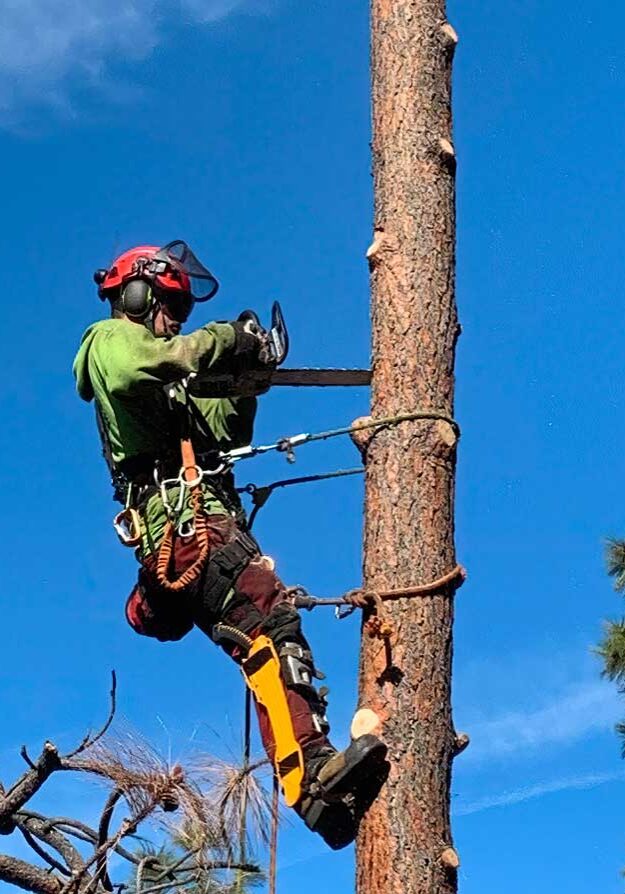
We rig before we cut. A throw line sets a climb line and a second line for lowering. Even for ground work, a speedline from a high tree to a lower anchor can move branches clear of a roof without loading weak points. In tight spaces, a portable capstan winch on a buried anchor or a truck hitch gives controlled pulls without driving heavy equipment onto sensitive soil.
We segment mass. Instead of taking a 12 foot log in one slice, we stair-step small cookies, each one relieving a portion of the load. When a tree is resting on a structure, we often build temporary cribbing and use simple wedges or airbags to lift tiny amounts, then cut, then re-chock. Patience prevents surprises.
We lean on cranes when the risk mathematics says to. A crane can pluck heavy sections without adding side load to a cracked stem or a sagging roof. That said, wind gusts above safe limits or poor access can make crane work more dangerous than ropes, so we switch tactics as conditions dictate.
Working around utilities without becoming the headline
No private crew should cut within close proximity of energized lines without the utility involved. That is not just policy, it is physics. Wood and tools conduct when wet. Ice can bridge gaps you think are safe. The right move is to report lines down or trees on lines to the utility, then have your tree company coordinate once de-energized or made safe. In many jurisdictions, only line clearance certified crews are authorized to work within the utility’s clearance zone. A good estimator will know where those boundaries lie and will stage the work so your home is protected while everyone stays inside the rules.
Service masts and weatherheads on homes are a gray area. They are your property, yet they are part of the electrical system. If a limb tears the mast away from the wall, have an electrician and the utility in the loop before repairs. We can tarp and remove load without touching the electrical components, then step back.
Winter specifics that change the plan
Frozen ground is a blessing and a trap. It supports equipment and reduces rutting, which makes cleanup gentler on lawns. But frost depth varies. A crane’s outrigger pad that feels solid at dawn can thaw by noon sun and creep. We use pads that spread the load and check them often. On steep drives, chains and sand help, but there are days when we park on the street and hand carry because safe access beats speed every time.
Snow hides hazards. That landscaping boulder near the maple does not care that it is covered. We probe with a spud bar before making hinge cuts or letting a piece swing. A hidden retaining wall can kick a log back at knee height. Crews move slower because we spend time finding the ground we want to stand on.
Ice changes everything about footing and fiber. Crampons designed for arborist boots, not trail spikes, make a difference on frozen bark. We also bump our minimum crew size by one on icy days, not for cutting speed, but to add a dedicated ground person watching line angles, not a saw. That extra set of eyes pays off when a branch takes an unexpected path because a frozen twig holds longer than usual.
Stump Removal & Grinding in cold weather
People often assume you cannot grind stumps in winter. You can, more often than not. If frost is shallow, a stump grinder will chew right through it. The chips may mix with icy soil, which makes for heavier cleanup, but the job gets done. Deep frost can make access the limiting factor. Machinery on slick slopes is a poor idea, and we will tell you so. Utilities remain a non-negotiable step year round. Call for locates before any Stump Removal & Grinding, and expect flags and paint marks. In winter, we tarp the area ahead of time to reduce frost depth, or we schedule grinding for the first thaw. Either way, backfilling the hole with chips and a soil cap sets you up for spring seeding.
Prevention that pays off before the next storm
A strong tree becomes a weak lever if neglected. Preventive care is quieter and less dramatic than a crane at midnight, but it moves the needle on risk.
Tree Pruning & Crown Shaping, done at the right time, cultivates structure. On young trees, structural pruning sets a dominant leader and removes or reduces competing co-dominant stems. On mature trees, selective thinning reduces sail without gutting the canopy. Targeted reduction on end weights shortens lever arms where unions are questionable. The numbers are modest, often a 10 to 20 percent reduction in live load, but that is enough in gusts to keep a marginal union intact. We avoid lion-tailing, which removes interior foliage and pushes stress to the tips, and we stay off flush cuts that damage collar tissues.
Tree Cable and Bracing is a corrective tool for specific defects, not a cure-all. A properly installed static cable, made from extra high strength steel and attached with through-bolts and lag eyes placed below the top third of the crown, ties co-dominant stems so they share load. Dynamic cabling systems that use synthetic materials allow movement but dampen shock. Rod bracing below a split reinforces the union. The right installation paired with crown reduction can extend the life of an important tree by decades. It demands inspection. We schedule annual or biannual checks to look for hardware wear, bark overgrowth, and any migration in the union.
FireSmart Tree Services may sound out of place in winter, yet they matter in shoulder seasons and drought years that increasingly follow snowy winters. Embers ride wind. A landscape with reduced ladder fuels, limbed-up conifers, and spaced crowns is less likely to carry fire to structures. The same spacing and understory thinning that reduce fire risk also trim the sail area that catches early season winds. We maintain a vegetation-free zone in the first 1.5 to 2 meters from structures where practical, choose less resinous species near buildings, and remove dead material that feeds both fire and winter breakage.
Soil and water matter more than gadgetry. Trees with deep, non-compacted root zones hold better in wind. Aeration with an air spade, mulch rings that start a hand’s width from the trunk and extend to the drip line, and judicious watering during late summer droughts build roots that pay off in winter. Fertilizers are not a bandage for structural issues, and we avoid heavy nitrogen before https://rivernbee136.cavandoragh.org/eco-conscious-stump-removal-grinding-alternatives-1 winter in species prone to late flushes. The goal is quiet vigor, not fast, weak growth.
Case notes from the field
Two snapshots illustrate how choices play out.
A sugar maple, about 28 inches at breast height, straddled a garage after a November gale. The tree had a subtle lean toward the building for years, with a buttress root flaring nicely on the uphill side. The storm added a torsional split at 10 feet, right where two co-dominant stems met. We could have taken it down with ropes, but the split propagated with each sway. We brought a 35 ton crane at dawn, set up on street pads, and removed the top sections in three picks. The crew of five finished the heavy cutting in under three hours, then spent the afternoon tarping and cleaning. The homeowner opted to remove the remaining trunk and grind the stump the following week. Insurance covered the removal from the structure and roof repairs. The takeaway was not just that a crane saved time, but that earlier structural pruning or a cable ten years prior would likely have prevented the co-dominant failure.
A white spruce, 45 feet tall, bent under ice and laid across a chain link fence, just kissing a corner of a shed. No power lines, no people risk, but a classic spring pole hazard. We set a line high in a neighboring tree and built a speedline to the driveway. Small sections rode the line away from the fence, keeping people out of the danger zone. The trunk still held energy. Relief kerfs on the compression side, then a slow back cut, bled off tension in safe increments. We left a 12 foot snag because the base fibers had twisted, and the homeowner liked the idea of a wildlife perch. Come spring, we returned for a crown reduction on the adjacent spruces to balance the stand and reduce sail. The fence survived with two posts replaced.
Navigating paperwork, neighbors, and the clock
Emergency work touches more than wood and steel. Permits in storm conditions are often relaxed, but historic districts and street tree ordinances may still require notice or a fast-track permit. Good companies have the forms ready and will help submit them. If a tree sits on a property line, involve the neighbor early. Shared costs are common when both parties benefit, but legal rights vary. Keep the conversation practical and document agreements in a short email to avoid misunderstandings later.
Insurance adjusters appreciate clear, dated photos and concise work descriptions. Before and after shots from similar angles help. Write down crew arrival and departure times, and note any coordination with the utility. If additional hidden damage appears, call the adjuster that day, not a week later. Many policies reimburse reasonable emergency tarping and temporary stabilization. Keep the receipts for tarps, screws, and even the batteries for your flashlight.
When to call for a Certified Arborist Consultation
If you are not sure whether your tree is safe to keep, or how to reduce risk without losing shade or privacy, a Certified Arborist Consultation buys clarity. Look for someone who will walk the site with you, not just send a bid. Expect a conversation about how you use your yard, where people spend time, and what you value most. A formal written assessment can include likelihood of failure and consequences that tie back to your home. The best consultations end with a plan that sequences work. For example, reduce and cable the big maple now, remove the topped birch next month, and set the young oaks up with structural pruning this winter. That sequence respects budgets and seasons while steadily cutting risk.
What comprehensive service looks like, from first call to last chip
The smoothest storm recoveries follow a rhythm. You call and get a live person who asks the right safety questions. A foreman arrives, sets clear expectations, and gets the immediate hazard under control. The crew handles the heavy work with a mix of mechanical advantage and caution, not bravado. They leave the site safe, swept, and documented. Cleanup and Stump Removal & Grinding happen when conditions allow, with utility locates in place. Follow-up pruning and Tree Cable and Bracing appointments are scheduled if keeping a tree makes sense. FireSmart Tree Services and Tree Pruning & Crown Shaping can be folded into that plan so this season’s crisis becomes next season’s prevention. Throughout, you get straightforward communication about costs and choices, not vague promises.
A final word on living with trees in storm country
Storms will keep testing trees. That is part of sharing a landscape with living structures that outlast vehicles and roofs. The good news is that the difference between a close call and a catastrophe often comes down to preparation and the first hour of response. If you give your trees thoughtful care, if you keep an eye on structure, and if you call for Emergency Tree Services that respect physics and process, you stack the odds in your favor.
When in doubt, ask. Dangerous Tree Assessment and Removal is a service, but it is also a conversation about acceptable risk, budgets, and aesthetics. Trees make our properties worth living in. They also demand a measure of respect when wind howls or ice glints. With the right plan, you can have both the shade and the safety, and you will sleep better the next time the forecast turns ugly.
Ace Tree Services Ltd.
Name: Ace Tree Services Ltd.Address: 4656 Wallace Hill Road, Kelowna, BC
Postal code: V1W 4C2
Phone: 250-212-9593
Website: https://acetree.ca/
Hours:
Monday: 7:00 AM - 5:00 PM
Tuesday: 7:00 AM - 5:00 PM
Wednesday: 7:00 AM - 5:00 PM
Thursday: 7:00 AM - 5:00 PM
Friday: 7:00 AM - 5:00 PM
Saturday: 7:00 AM - 5:00 PM
Sunday: Closed
Open-location code (plus code): RHF8+8G Kelowna, British Columbia, Canada
Map/listing URL: https://www.google.com/maps/place/Ace+Tree+Services+Ltd./@49.8232606,-119.4337283,659m/data=!3m2!1e3!4b1!4m6!3m5!1s0x537d8b1d074815c5:0x450b88afa7a41435!8m2!3d49.8232606!4d-119.4337283!16s%2Fg%2F11ydkpnh22
Embed iframe:
"@context": "https://schema.org", "@type": "HomeAndConstructionBusiness", "name": "Ace Tree Services Ltd.", "url": "https://acetree.ca/", "telephone": "250-212-9593", "address": "@type": "PostalAddress", "streetAddress": "4656 Wallace Hill Road", "addressLocality": "Kelowna", "addressRegion": "BC", "addressCountry": "CA" , "openingHoursSpecification": [ "@type": "OpeningHoursSpecification", "dayOfWeek": "https://schema.org/Monday", "opens": "07:00", "closes": "17:00" , "@type": "OpeningHoursSpecification", "dayOfWeek": "https://schema.org/Tuesday", "opens": "07:00", "closes": "17:00" , "@type": "OpeningHoursSpecification", "dayOfWeek": "https://schema.org/Wednesday", "opens": "07:00", "closes": "17:00" , "@type": "OpeningHoursSpecification", "dayOfWeek": "https://schema.org/Thursday", "opens": "07:00", "closes": "17:00" , "@type": "OpeningHoursSpecification", "dayOfWeek": "https://schema.org/Friday", "opens": "07:00", "closes": "17:00" ], "geo": "@type": "GeoCoordinates", "latitude": 49.8232606, "longitude": -119.4337283 , "hasMap": "https://www.google.com/maps/place/Ace+Tree+Services+Ltd./@49.8232606,-119.4337283,659m/data=!3m2!1e3!4b1!4m6!3m5!1s0x537d8b1d074815c5:0x450b88afa7a41435!8m2!3d49.8232606!4d-119.4337283!16s%2Fg%2F11ydkpnh22"
Ace Tree Services Ltd. provides professional tree removal, pruning, stump grinding, emergency response, and arborist consultations for properties in Kelowna and across the Okanagan Valley.
The company works with homes, commercial properties, and municipal settings where tree work needs to be planned carefully around buildings, fences, driveways, landscaping, and other site constraints.
Based in Kelowna, the team is positioned to help nearby neighbourhoods and surrounding Okanagan communities with routine tree care and time-sensitive storm cleanup.
Customers looking for careful tree work often want a crew with certified arborist training, insurance, and a methodical approach to higher-risk removals.
Services also include dangerous tree assessment, cabling and bracing, and wildfire risk reduction tree work for properties that need longer-term planning.
To request a quote or discuss tree care options, call 250-212-9593 or visit https://acetree.ca/.
A public map listing is available to help customers confirm the business location and get directions before a site visit or estimate.
For Kelowna property owners who need pruning, removals, or emergency tree help, a local tree service can make it easier to schedule site-specific recommendations and cleanup.
Popular Questions About Ace Tree Services Ltd.
What services does Ace Tree Services Ltd. provide?Ace Tree Services Ltd. lists tree removal, stump removal and grinding, tree pruning and crown shaping, emergency tree service, arborist consultation, dangerous tree assessment and removal, cabling and bracing, and wildfire risk reduction tree work.
Who does Ace Tree Services Ltd. serve?
The company describes its work as serving homes, businesses, and municipalities in Kelowna and across the Okanagan Valley.
Is emergency tree help available?
Yes. Emergency service is listed for downed or uprooted trees, dangerous tree assessment, stabilization work, and branch cleanup. If a tree is near power lines, the safest first step is to stay clear and contact the utility provider before any tree work begins.
Do I always need a permit to remove a tree?
Not always. Permit requirements can depend on where the tree is located and whether it is near a creek, lake, steep slope, or another protected area. It is best to check local rules for the specific property before removal work starts.
How deep does stump grinding usually go?
Standard stump grinding is typically described as going about 6 to 12 inches below ground level, which is often enough for grass or surface landscaping. Deeper grinding may be possible when site plans call for it.
How much of a tree can be safely removed at one time?
That depends on the species, age, health, and structure of the tree. In practice, good pruning is usually about removing the right limbs for health, clearance, and structure rather than chasing a fixed percentage.
What are common signs that a tree may be dangerous?
Large dead limbs, visible cracks, a new lean, root damage, canopy dieback, or storm-related damage can all be warning signs. Trees near structures deserve extra attention when any of those issues appear.
What is cabling and bracing in tree care?
Cabling and bracing are support systems used to reduce the risk of failure in trees with structural weaknesses that may still be worth preserving. They are generally used to add support, not to replace good assessment and ongoing maintenance.
How do I contact Ace Tree Services Ltd.?
Call 250-212-9593.Website: https://acetree.ca/.
Landmarks Near Kelowna, BC
Downtown KelownaThe downtown core is a practical reference point for lakefront neighbourhoods, mixed-use streets, and central residential properties. If your property is near downtown, tree pruning, removals, and cleanup can be planned around tighter access and nearby structures.
Knox Mountain Park
This well-known park north of downtown is a recognizable landmark for nearby homes and hillside properties. If you are close to this area, ask about tree assessment, trimming, or removal work suited to sloped sites.
Mission Creek Greenway
The greenway runs through several parts of Kelowna and is a useful landmark for nearby residential areas. If your property borders or sits near this corridor, site-specific tree planning is especially important.
Pandosy Village
Pandosy is one of Kelowna’s most recognizable neighbourhoods and a common reference point for south-central properties. If you are nearby, request help for pruning, removals, or storm cleanup around homes and small commercial sites.
Rutland
Rutland is a major east Kelowna neighbourhood with a mix of residential and local commercial properties. If you are located in or near Rutland, tree work can be scheduled for both routine maintenance and urgent situations.
Landmark District
This central business-focused area is a practical landmark for offices, service properties, and nearby residential streets. If your site is near the district, ask about careful tree work around parking, access lanes, and built-up lots.
Kelowna’s North End
The North End sits on the edge of downtown and is a useful reference for nearby homes, industrial sites, and commercial properties. If you are in this part of the city, request tree care based on the layout and constraints of the lot.
Airport District
The Airport District is a recognizable north Kelowna reference point for surrounding properties and access routes. If you are in this area, ask about tree services for residential acreage, commercial sites, or roadside cleanup needs.
Glenmore & Dilworth
These established Kelowna neighbourhoods are useful landmarks for central and north-central service calls. If your property is nearby, pruning and removal work can be tailored to mature trees and established landscapes.
Highway 97 Corridor
Highway 97 is one of the city’s main travel routes and a common way to describe location within Kelowna. If your home or property is just off the corridor, a clear landmark reference can help speed up quote scheduling and site planning.