Preemptive Dangerous Tree Assessment and Removal Strategy
Trees fail quietly for years, then all at once. I have stood under a leaning Douglas fir after a March rain and watched the soil breathe at the root plate with every gust, a slow heartbeat that meant the anchoring roots were letting go. The homeowner had noticed mushrooms, chalked them up to autumn charm, and ignored a driveway crack that changed half an inch over a season. Those small tells matter. Preemptive assessment and action save roofs, vehicles, and sometimes people. They also save good trees by steering interventions early, before damage forces drastic measures.
This article lays out a practical, field-tested approach to identifying and managing hazardous trees before they become emergencies. It blends observation, science, and the realities of budgets, neighbors, and municipal rules. It also frames where different services fit, from Certified Arborist Consultation to Emergency Tree Services and Stump Removal & Grinding, so planning translates into clear decisions.
What “dangerous” means in real life
Risk with trees is a product of two things: the likelihood a part will fail and the consequence if it does. An 80-foot cottonwood with a decayed stem over a daycare is a different risk than the same tree in a pasture. In practice, I look at three axes: defects that increase likelihood of failure, exposure of targets, and the timeframe for action.
Defects include decay, root damage, co-dominant stems with included bark, large deadwood, overextended limbs, past topping cuts, and soil issues like saturation or compaction. Target exposure ranges from bedrooms and power lines to driveways and frequently used patios. Timeframe can shorten fast. After long droughts, the first saturating fall storm often produces root failures because desiccated fine roots cannot handle the sudden load. A tree that felt safe in June can be precarious in October.
Preemptive strategy starts with observation, then moves to diagnostics, then to choices: prune, cable, reduce, monitor, or remove. There is no virtue in waiting if the data say failure is likely. There is also no need to rush to removal when structural pruning or crown shaping will correct the defect and keep the tree.
Reading the tree: field cues that matter
Most homeowners know when they do not like a lean. The trick is knowing which leans are normal and which are problems. Trees that develop a lean young can compensate with reaction wood and broad roots. I worry more when a lean changes within a season, especially after storms or irrigation changes. I carry a small plumb bob and an angle app on my phone. A lean that grows by more than 2 degrees over a year demands a closer look at the root plate and soil moisture.
Crown transparency tells another story. If you can see more sky through the canopy of a deciduous tree than you did last year, something changed. That could be normal age or it could be root decline. In conifers, thinning at the top relative to lower branches often indicates root stress or stem disease progressing upward.
Bark cracks that spiral, sunken areas, and seams with black ooze point toward internal decay. Fungal conks at the base, like Ganoderma or Armillaria mushrooms, do not always mean imminent failure, but they increase odds. I note the species too. Cottonwood and willow compartmentalize decay poorly compared to oak; a 20 percent hollow in a willow is more serious than the same in a mature white oak.
Finally, I look down. Heaving soil on the compression side of a lean, gaps opening on the tension side, and fresh cracks in sidewalks within the radius of the root plate are all signals. Irrigation changes matter. A new lawn under an old native oak often introduces rot fungi and shallow roots that destabilize the tree over three to seven years.
When to call for a Certified Arborist Consultation
There is a point where casual observation stops being helpful. If you suspect decay in the stem or major roots, bring in a qualified professional. A Certified Arborist Consultation pays for itself when it saves either a tree or a deductible. Expect a proper assessment to combine visual inspection, sounding with a mallet, resistance drilling for decay mapping if needed, and possibly sonic tomography for high-value trees. On crowded urban sites, we use portable radar or air spade excavation around buttress roots to look for girdling or severed roots without harming them.
A solid consultation ends with a clear risk rating, options, and timelines. Good arborists do not sell fear. They show you data, explain failure modes in plain language, and lay out what interventions can change the risk profile.
A preemptive strategy that works
Here is a simple framework I use with clients when a tree could be hazardous but the right response is not obvious.
- Identify the specific defect and the likely failure mode. Example: co-dominant stems with included bark at 20 feet likely to split under wind load.
- Quantify targets and exposure. Map where people, vehicles, structures, and lines are within striking distance.
- Evaluate site factors that amplify risk. Saturated clay, recent excavation, prevailing wind direction, or added irrigation can tip a marginal case.
- Match interventions to defects. Structural pruning, Tree Cable and Bracing, crown reduction, soil remediation, or removal all have roles.
- Decide on timing and monitoring. Some fixes buy time; others resolve the problem. Set reinspection dates and thresholds for change.
Pruning and crown shaping as risk control
Tree Pruning & Crown Shaping remain the most underused risk reduction tools. When done properly, pruning shifts load paths, removes defects, and preserves a tree’s form.
On young and middle-aged trees, structural pruning pays long-term dividends. Removing one of two competing leaders early prevents the classic V-shaped union that later splits. Reducing overextended limbs by 10 to 20 percent shortens lever arms and cuts bending moments, which lowers the chance of limb failure in storms without scalping the tree. On older trees, crown cleaning to remove deadwood and crossers reduces both sail and the chance of bark wounds that invite decay.
I avoid hard topping. It creates a flush of weakly attached regrowth and decay points, raising risk rather than reducing it. If a client needs height reduction for a solar array or to clear lines of sight, I use drop-crotch reductions that keep natural form and redirect growth.
Pruning schedules matter. I often recommend a two-phase approach in the first year for heavily loaded crowns: an initial reduction to stabilize, then a fine-tuning pass one growing season later once the tree responds. Spreading the work also spreads the physiological impact on the tree, especially for species sensitive to heavy cuts.
Tree Cable and Bracing where structure warrants it
Mechanical support is not a substitute for good structure, but it has a place. I specify Tree Cable and Bracing when a valuable tree has inherent structural weaknesses that pruning alone cannot reconcile. Co-dominant leaders with included bark can be stabilized with a dynamic cabling system high in the crown that limits separation while allowing movement. Static steel cabling or through-bolting is sometimes required for older, heavier leaders, especially in hardwoods.
Installation quality is everything. Anchor points must be located within the upper third of the crown for cabled unions, with load distribution in mind. Spacer thimbles and proper rope diameters extend service life. Every system needs inspection at least every two to three years, more often after major storms. I tell clients to treat cabling as a seatbelt for the tree. It reduces severity in a crash but does not make reckless driving safe. If decay progresses past a threshold, even cabled trees still come down.
Soil, roots, and the hidden half of risk
Half the tree lives below grade, and many failures begin there. I have seen more windthrow after new driveways than after windstorms, because trenching sliced lateral roots on one side. Whenever a tree grows within two to three trunk diameters of planned excavation, bring in an arborist before the work. Root mapping with air tools can locate critical roots so contractors can reroute utilities or bridge roots where trenching is unavoidable.
Soil compaction increases risk by starving roots of oxygen. You can feel it with a penetrometer, or with a simple screwdriver test. If you cannot sink it by hand near the dripline after rain, the soil is compacted. Mechanical decompaction with an air spade, followed by mulch and fungal-dominant compost, often revives struggling trees over a couple of seasons. Do not smother the trunk flare with mulch; leave the buttress roots visible so water and fungi do not collect against bark.
Drainage matters too. On slopes where winter rains saturate clay, even healthy trees can fail. Swales and subsurface drains that move water downslope away from root zones cut risk significantly. I pair that with selective crown reduction on the upslope side to reduce wind sail.
FireSmart Tree Services in wildland-urban edges
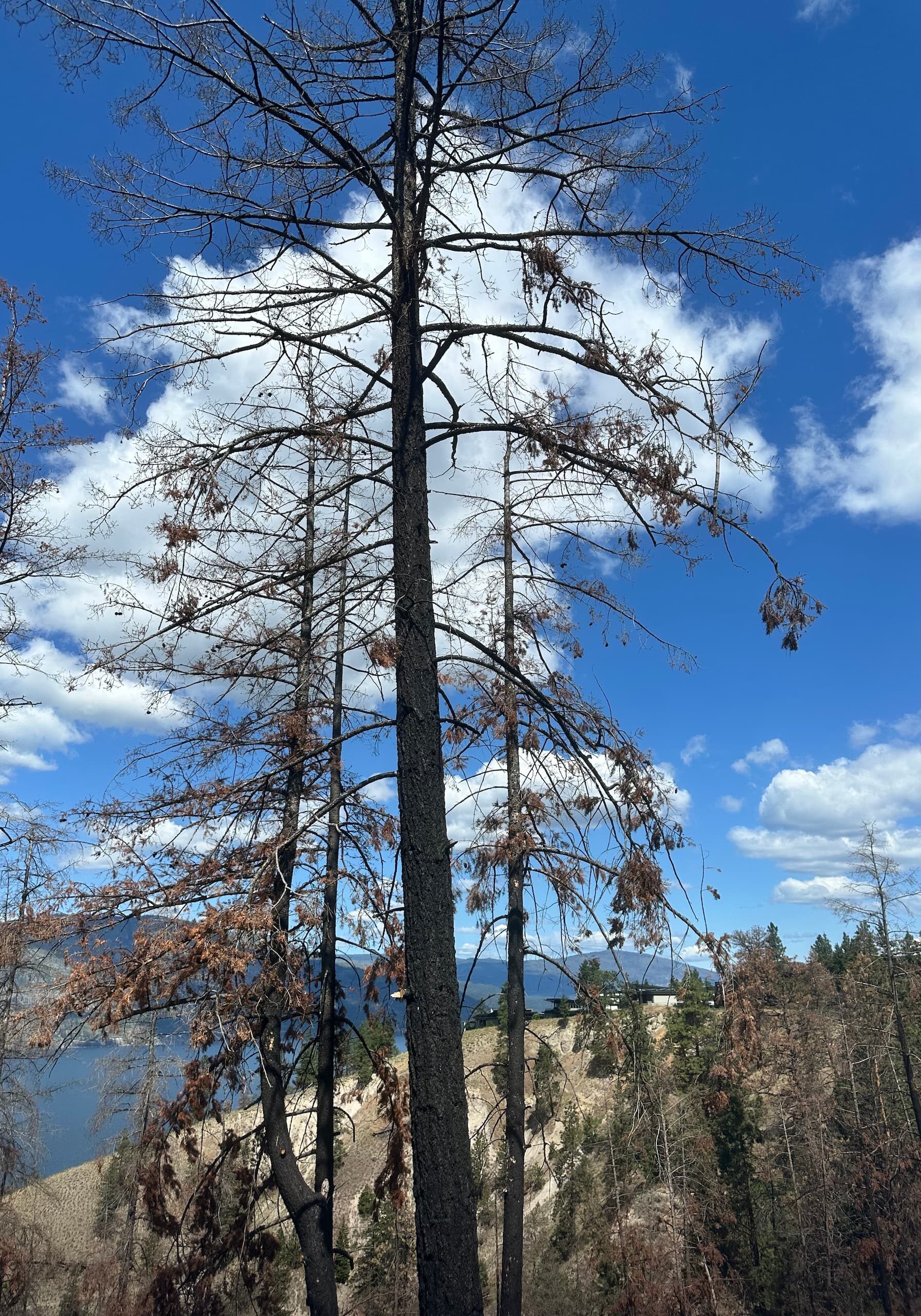
Where fire is a major hazard, dangerous tree planning must include FireSmart Tree Services. That means removing ladder fuels, spacing crowns, and breaking up continuity between shrubs and lower limbs. I often recommend lifting the canopy base of pines to 8 to 10 feet where code allows, while preserving enough interior foliage for tree health. Deadwood removal is non-negotiable near structures.
Not every risky tree is a burn hazard, but those that are deserve priority in budgets. A declining juniper 12 feet from a wooden deck is not just a wind risk, it is a torch. Combining fire and wind considerations can shift the decision from retention to removal even if either hazard alone seems moderate.
The hard call: removal
Dangerous Tree Assessment and Removal is plain language for the day there are no good alternatives. When decay hollows more than about a third of a stem diameter in species that compartmentalize poorly, removing the tree usually beats heroic cabling. Same for root rot confirmed in main structural roots. If the tree threatens a bedroom or a neighbor’s eaves, the margin for error narrows.
Modern Tree Removal Services handle complex sites with cranes, rigging, and climbers who know how to dismantle in tight quarters. On the ground, spotters protect foot traffic and property. In winter storms I have coordinated with utility crews to de-energize lines, then used a 27-ton crane to lift out sections over a greenhouse with less than two feet of tolerance on each side. Planning and communication turn risky removals into routine days.
When clients ask how much removal costs, I give ranges with clear drivers. A straight, open-fall felling of a 40-foot maple into a pasture might be under a thousand dollars. A 90-foot spruce over a house, pieced out with a crane and traffic control, can run several thousand. Add in stump grinding and site restoration, and you have a realistic budget.
Stumps, roots, and what comes after
A stump is not a neutral object. It attracts ants, heaves pavers, and sprouts in some species like poplar. Stump Removal & Grinding solves most of that. I usually grind 6 to 12 inches below grade for lawn and replanting in grass. For new trees or patios, I go deeper and wider, then excavate woody debris to avoid future settling. If irrigation lines or utilities cross the area, probe and mark them before the grinder arrives.
In clay soils, I backfill the hole with a mix of native soil and a coarse, well-draining material, then top with mulch. Avoid backfilling with pure grindings, which decay and collapse. When replanting, place the new tree off-center from the old stump so roots find uncompacted soil quickly. Choose species suited to the site and its constraints, not just what looked good at the nursery.
Timing decisions and seasonal windows
There is a better and worse time to cut. Deciduous pruning while dormant often produces steady wound closure with less stress, though oaks and elms need specific timing to avoid disease vectors. In heat waves, heavy pruning stresses trees more than it helps. For removal, frozen ground can be a blessing if access is tricky. In saturated shoulder seasons, protect lawns with mats and lighter equipment to avoid ruts that cost more to fix than the tree work.
Storm seasons compress timelines. I encourage clients to schedule Certified Arborist Consultation in late summer, then complete pruning or cabling before the first major fall systems. If a tree already shows progressive lean or soil heave, do not wait. Once Emergency Tree Services are all that is left, your options narrow and costs rise.
The role of monitoring and documentation
Trees change slowly until they change quickly. I keep a simple log for high-risk cases: date-stamped photos from the same angle, notes on crown density, conk presence, lean angle, and ground cracks. Even a basic record helps a homeowner see trends they might otherwise dismiss. I suggest rechecks after major weather, especially if winds exceed local thresholds that historically produce failures, which in many coastal zones is in the 40 to 60 mph range for exposed sites.
For trees with cabling, set a calendar reminder for inspection intervals. For recently pruned trees, identify and mark any cuts that require follow-up. Documentation also matters for insurance. If you can show that you sought professional advice and followed recommendations, claims and neighbor relations go more smoothly if something fails despite care.
Coordinating with neighbors and utilities
Many hazardous trees straddle property lines, emotionally and physically. When a trunk grows right at a fence, each neighbor may own a share or local law may treat it as a boundary tree. I have smoothed more than one tense conversation by bringing both parties into the assessment early and putting findings in writing. If removal is the right call, cost-sharing often becomes possible when both parties understand the risk clearly.
Utilities require coordination. Trees near primary lines demand clearances that homeowners do not always accept easily. Private Tree Removal Services can work near service drops after coordination, but primary lines usually require utility crews to make the site safe. Build that into schedules. If a root zone overlaps a gas line, call for utility locating before any Stump Removal & Grinding.
When emergency response is the only option
Despite planning, trees still fail at night in wind and rain. Emergency Tree Services exist for that reason. Good teams mobilize quickly, stabilize the scene, and remove hazards without making the problem worse. On a January night I answered a call for a red oak through a garage roof. The priority was temporary shoring and tarping, then careful piecing to avoid widening the breach. The homeowner had facesheet insurance limits in mind; I had gravity and the weather forecast. Communication kept us aligned.
If you find yourself in this situation, keep people clear, secure pets, and take photos from a safe distance. Do not climb on compromised structures. Call your insurer after you call the emergency crew. If power lines are involved, assume they are live and keep at least 30 feet away.
Costs, value, and the long view
The cheapest choice is not always the lowest cost over time. Spending a few hundred dollars on a Certified Arborist Consultation and targeted Tree Pruning & Crown Shaping today may postpone or eliminate a multi-thousand-dollar removal later. Conversely, waiting a year on a tree with advancing root rot can turn a controlled removal into a dangerous scramble with crane rental and night rates. The value of early action shows up in numbers but also in sleep quality when the forecast shifts to wind and rain.
I advise clients to budget annually for tree care like they do for roof maintenance. Five percent of landscaping value per year is a reasonable planning figure for mature properties, adjusted for tree density and site complexity. Spreading costs smooths surprises and ensures there is money for the right job at the right time.
Permits, wildlife, and ethics
Many towns require permits for removal above certain trunk diameters or for protected species. Check before you cut. Penalties can be steep. During nesting season, https://martinzafn008.timeforchangecounselling.com/precision-stump-removal-grinding-for-smooth-lawns-1 especially from spring into early summer, we survey for active nests. If we find one, we adjust schedules. Good arboriculture respects wildlife timing even when the law does not strictly compel it, provided no imminent hazard exists. If a tree is truly dangerous, document the risk, coordinate with the city if applicable, and proceed with care.
Urban forestry also has an equity dimension. Removing a mature shade tree can raise local temperatures by several degrees on summer afternoons, driving up cooling costs for neighbors if there is little canopy left. When removal is necessary, plan for replacement trees that restore shade and habitat. The best time to plant replacements is the same day you approve removal, not two years later when memories fade.
A short homeowner checklist
Use this quick screen to decide if you need a professional assessment soon.
- Visible fungal conks at the trunk base, or mushrooms recurring in the same ring each year near roots
- A lean that grew noticeably within one season, or fresh soil heave and cracking near the root plate
- Co-dominant stems with a tight V union, visible bark inclusion, or long horizontal cracks at a fork
- Large dead limbs over walkways, roofs, or play areas, especially after recent storms
- Recent excavation, new irrigation, or grade changes within the dripline of a mature tree
If any of these describe your situation, schedule a Certified Arborist Consultation. If the tree already moved after a storm or is actively shedding large limbs, call for Emergency Tree Services.
Pulling it all together
A preemptive dangerous tree strategy is not a single decision, it is a sequence. Look carefully, gather data, and match interventions to what the tree is telling you. Use Tree Cable and Bracing for unions worth saving, not to postpone the inevitable. Lean on Tree Pruning & Crown Shaping to correct structure before it becomes a crisis. When risk and consequence are high and defects are advanced, choose Dangerous Tree Assessment and Removal and follow through with Stump Removal & Grinding and thoughtful replanting. Where fire is part of the picture, fold FireSmart Tree Services into your plan so wind and flame are both accounted for.
I still think about that leaning Douglas fir from March. We reduced the sail by 15 percent on the windward side, installed a dynamic cabling system between the main leaders, and built a shallow swale upslope to move winter water away from the roots. Two seasons later, the crown filled in evenly and the root plate stopped pulsing in wind. We set a three-year inspection interval. Not every story ends with a save. Enough do to make careful assessment and timely action worth the effort.
Ace Tree Services Ltd.
Name: Ace Tree Services Ltd.Address: 4656 Wallace Hill Road, Kelowna, BC
Postal code: V1W 4C2
Phone: 250-212-9593
Website: https://acetree.ca/
Hours:
Monday: 7:00 AM - 5:00 PM
Tuesday: 7:00 AM - 5:00 PM
Wednesday: 7:00 AM - 5:00 PM
Thursday: 7:00 AM - 5:00 PM
Friday: 7:00 AM - 5:00 PM
Saturday: 7:00 AM - 5:00 PM
Sunday: Closed
Open-location code (plus code): RHF8+8G Kelowna, British Columbia, Canada
Map/listing URL: https://www.google.com/maps/place/Ace+Tree+Services+Ltd./@49.8232606,-119.4337283,659m/data=!3m2!1e3!4b1!4m6!3m5!1s0x537d8b1d074815c5:0x450b88afa7a41435!8m2!3d49.8232606!4d-119.4337283!16s%2Fg%2F11ydkpnh22
Embed iframe:
Ace Tree Services Ltd. provides professional tree removal, pruning, stump grinding, emergency response, and arborist consultations for properties in Kelowna and across the Okanagan Valley.
The company works with homes, commercial properties, and municipal settings where tree work needs to be planned carefully around buildings, fences, driveways, landscaping, and other site constraints.
Based in Kelowna, the team is positioned to help nearby neighbourhoods and surrounding Okanagan communities with routine tree care and time-sensitive storm cleanup.
Customers looking for careful tree work often want a crew with certified arborist training, insurance, and a methodical approach to higher-risk removals.
Services also include dangerous tree assessment, cabling and bracing, and wildfire risk reduction tree work for properties that need longer-term planning.
To request a quote or discuss tree care options, call 250-212-9593 or visit https://acetree.ca/.
A public map listing is available to help customers confirm the business location and get directions before a site visit or estimate.
For Kelowna property owners who need pruning, removals, or emergency tree help, a local tree service can make it easier to schedule site-specific recommendations and cleanup.
Popular Questions About Ace Tree Services Ltd.
What services does Ace Tree Services Ltd. provide?Ace Tree Services Ltd. lists tree removal, stump removal and grinding, tree pruning and crown shaping, emergency tree service, arborist consultation, dangerous tree assessment and removal, cabling and bracing, and wildfire risk reduction tree work.
Who does Ace Tree Services Ltd. serve?
The company describes its work as serving homes, businesses, and municipalities in Kelowna and across the Okanagan Valley.
Is emergency tree help available?
Yes. Emergency service is listed for downed or uprooted trees, dangerous tree assessment, stabilization work, and branch cleanup. If a tree is near power lines, the safest first step is to stay clear and contact the utility provider before any tree work begins.
Do I always need a permit to remove a tree?
Not always. Permit requirements can depend on where the tree is located and whether it is near a creek, lake, steep slope, or another protected area. It is best to check local rules for the specific property before removal work starts.
How deep does stump grinding usually go?
Standard stump grinding is typically described as going about 6 to 12 inches below ground level, which is often enough for grass or surface landscaping. Deeper grinding may be possible when site plans call for it.
How much of a tree can be safely removed at one time?
That depends on the species, age, health, and structure of the tree. In practice, good pruning is usually about removing the right limbs for health, clearance, and structure rather than chasing a fixed percentage.
What are common signs that a tree may be dangerous?
Large dead limbs, visible cracks, a new lean, root damage, canopy dieback, or storm-related damage can all be warning signs. Trees near structures deserve extra attention when any of those issues appear.
What is cabling and bracing in tree care?
Cabling and bracing are support systems used to reduce the risk of failure in trees with structural weaknesses that may still be worth preserving. They are generally used to add support, not to replace good assessment and ongoing maintenance.
How do I contact Ace Tree Services Ltd.?
Call 250-212-9593.Website: https://acetree.ca/.
Landmarks Near Kelowna, BC
Downtown KelownaThe downtown core is a practical reference point for lakefront neighbourhoods, mixed-use streets, and central residential properties. If your property is near downtown, tree pruning, removals, and cleanup can be planned around tighter access and nearby structures.
Knox Mountain Park
This well-known park north of downtown is a recognizable landmark for nearby homes and hillside properties. If you are close to this area, ask about tree assessment, trimming, or removal work suited to sloped sites.
Mission Creek Greenway
The greenway runs through several parts of Kelowna and is a useful landmark for nearby residential areas. If your property borders or sits near this corridor, site-specific tree planning is especially important.
Pandosy Village
Pandosy is one of Kelowna’s most recognizable neighbourhoods and a common reference point for south-central properties. If you are nearby, request help for pruning, removals, or storm cleanup around homes and small commercial sites.
Rutland
Rutland is a major east Kelowna neighbourhood with a mix of residential and local commercial properties. If you are located in or near Rutland, tree work can be scheduled for both routine maintenance and urgent situations.
Landmark District
This central business-focused area is a practical landmark for offices, service properties, and nearby residential streets. If your site is near the district, ask about careful tree work around parking, access lanes, and built-up lots.
Kelowna’s North End
The North End sits on the edge of downtown and is a useful reference for nearby homes, industrial sites, and commercial properties. If you are in this part of the city, request tree care based on the layout and constraints of the lot.
Airport District
The Airport District is a recognizable north Kelowna reference point for surrounding properties and access routes. If you are in this area, ask about tree services for residential acreage, commercial sites, or roadside cleanup needs.
Glenmore & Dilworth
These established Kelowna neighbourhoods are useful landmarks for central and north-central service calls. If your property is nearby, pruning and removal work can be tailored to mature trees and established landscapes.
Highway 97 Corridor
Highway 97 is one of the city’s main travel routes and a common way to describe location within Kelowna. If your home or property is just off the corridor, a clear landmark reference can help speed up quote scheduling and site planning.