Same-Day Tree Removal Services for Hazardous Situations
When a tree fails, the clock starts. A limb through a roof during a wind gust, a heaving root plate after three days of rain, a cottonwood leaning across a live power line, these are not weekend projects. Same-day Emergency Tree Services exist for one reason: reduce immediate risk to people, property, and utilities. The work is technical and often performed under pressure, and the decisions made in the first hour set the tone for safety and cost over the rest of the job.
I have spent enough storm nights on rope to know what matters: fast triage, calm communication, and good judgment on whether to remove, reinforce, or isolate the hazard. Below is a clear-eyed look at how same-day Tree Removal Services handle dangerous situations, what homeowners can expect, and how to prepare.
What qualifies as hazardous, and why timing matters
Not every leaning trunk needs a crane before sunset. Hazard status comes from a mix of defect, target, and likelihood of failure. A dead ash 60 feet from a barn is a different calculation than a cracked cottonwood https://edwinbqzs079.raidersfanteamshop.com/emergency-tree-services-for-leaning-trees-and-uproots over a daycare parking lot. The assessment we perform weighs four things: the severity of structural defects, weather loading like wind or snow, occupancy of the area below the tree, and the potential for cascading damage if the tree fails.
There are red flags that consistently move a job into the same-day lane. A trunk crack that opens and closes with wind, sudden ground heave or a bulged root plate, fresh soil cracking on the tension side of a lean, and branches that have torn and are lodged aloft, often called widowmakers. Utility involvement forces the issue, and so does a tree that has already contacted a structure. If the situation can worsen in the next storm cycle, we mobilize crews.
Time affects risk physics. Saturated soils reduce root friction by orders of magnitude, often turning stable leans into uproots with one more gust. Snow loading can double the static weight on weak unions. Heat and wind after fire can dry out dead conifers and turn them into fuel within days. Acting the day of discovery is often the cheapest moment to act, not the most expensive, because you still control part of the scene.
What happens when you call for help
On emergency calls, a dispatcher and a lead arborist triage within minutes. We ask where the tree stands, what it is touching, and what you are hearing and seeing, creaking, snapping, live wires arcing. Good photos help, but safety comes first, do not walk under the canopy to get a better angle. We cross-check power company hotlines if utilities are involved, and in some jurisdictions we notify municipal public works if the public right-of-way is blocked.
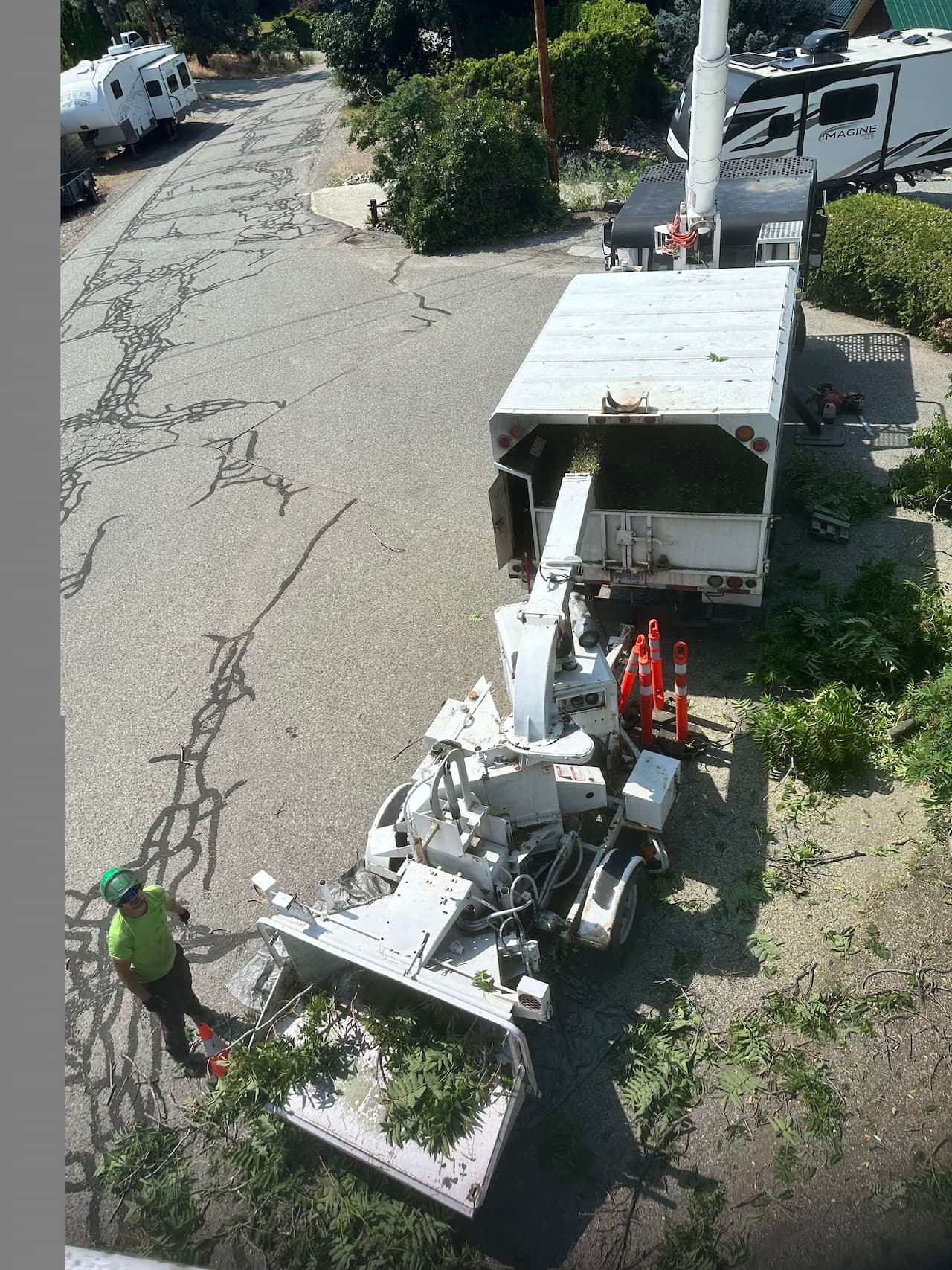
Same-day mobilization depends on the scale. For a hung limb over a driveway, a two-person crew with a bucket truck and rope rigging may roll in under two hours. For a 100-foot crane removal over a house footprint, expect staggered arrivals. A scout truck to stabilize the site, a chipper and loader for debris, then a crane that may require a temporary road closure and a permit if the street is narrow. If the tree is in a wildfire interface zone, we will also bring FireSmart Tree Services gear like pumps, hose, and spark arrestors, especially during high-risk burn bans.
Dispatch is one part logistics and one part chess. We hedge for night work with extra lighting, spare rigging, and redundant saws. We pre-clear a dump site. In heavy storm cycles, we run crews in shifts to keep reaction time under six hours while preserving safety.
Certified Arborist Consultation under pressure
A Certified Arborist Consultation done at the curb still follows standards. We identify species and defect type, which tells us how wood will behave under load. Maples tend to fiber pull under rigging, eucalyptus can shear without warning, and old elms rot from the center outward, leaving a shell that looks sound. We look for load paths and swing radii, then locate drop zones and tie-in points. If aerial work is required, we watch wind gust intervals and compare to the tree’s damping response. A tree that whips and oscillates with a slow return tells me interior decay is likely.
The consultation focuses on three choices in this order: remove now, stabilize then remove, or isolate and monitor. Removal is obvious when defect meets target over a short time horizon. Stabilization often comes through Tree Cable and Bracing, plus selective weight reduction through crown thinning. Isolation may mean fencing off a section of yard or closing a driveway if the target can be moved. The difference between an $800 stabilization and a $6,000 emergency removal often comes from how early we see the defect.
Dangerous Tree Assessment and Removal, the field decisions
I keep a mental matrix for dangerous tree work. A crack at a union with wind loading and people below, cut the load path. A root plate failure within the last 24 hours with no direct target and stable weather, consider bracing the stem with a guy line, then perform a controlled dismantle with a ground anchor. A stem that is embedded in a roof, resist the urge to pull fast. You want to suspend and cut free in sections, not lever more loads into the structure.
Crane picks are not a cure-all. They increase safety margins over critical targets, but they require setup room, outriggers on sound pads, and clear communication with a signaler. On tight urban lots, negative rigging off a sparsely loaded spar can be safer. We score bark and install friction devices at the trunk, then cut manageable blocks that descend under controlled friction into a protected landing zone. Modern devices like bollards and floating rigging anchors allow us to lower several hundred pounds smoothly without shock loading the remaining structure.
At night or in rain, plan to slow down. Wet bark reduces foot traction, and sound changes in wood, making it harder to read your cuts. We favor rope access over spikes on live trees we might retain, but in true emergency removals, speed may dictate climbing spikes and direct ascent to position. That is a judgment call you want a seasoned climber to make.
Utility lines and who does what
If a tree touches a service drop, that thin line from the pole to your house, we can often coordinate with the utility to de-energize temporarily. If the tree is on primary lines, the crews with authority are the utility’s or their approved subcontractors. We maintain relationships so the handoff is smooth. On mixed jobs, we isolate the area, establish a hot zone, and wait for clearance rather than guessing. A 7,200-volt line can arc through damp air. No cut is worth guessing wrong.
On underground utilities, we call locates if excavation is required for Stump Removal & Grinding or root collar exposure. In emergencies we can leave stumps tall to return later, but we note locations so delayed grinding does not tear into gas or fiber.
Permits, neighbors, and access reality
Municipalities vary. Some waive permits for Emergency Tree Services when a tree has struck a structure or blocks a public right-of-way. Others require an after-action permit within a set number of days, often 3 to 10. Heritage and street trees are a different universe, with city arborists who must sign off. We help navigate this, photograph defects, and document the hazard so you have a record for the permit file or insurance.
Neighbors matter. Access through a side yard can save hours, but only if you ask. A crane outrigged on a neighbor’s driveway may need written permission. We bring ground protection mats to avoid ruts on lawns and take pictures of pre-existing damage so everyone stays friendly.
How pricing works under emergency conditions
Same-day work is not guesswork, but it is not flat-rate either. Expect a site minimum that covers mobilization, typically a few hundred dollars, and hourly rates for labor, specialized equipment, and disposal. Crane time is billed by the hour or half-day, with travel included. Night, holiday, and storm surge conditions add premiums because we staff more people and carry overtime. Insurance claims sometimes cover part or all of the job if the tree caused damage to a covered structure. Insurers like tight, dated estimates and an invoice that separates labor, equipment, and disposal. We provide them.
As a rough range from recent seasons: a simple emergency limb removal off a single-story roof may land between $600 and $1,200. A full Dangerous Tree Assessment and Removal with a crane over a house, $4,000 to $12,000 depending on size, access, and cleanup. Complex multi-day storm jobs that include road clearing, multiple trees, and Stump Removal & Grinding can exceed $15,000. Preventive money is cheaper. Annual Tree Pruning & Crown Shaping and proactive cabling often keep you out of the emergency lane for a fraction of that.
When removal is not the first answer
We remove a lot of trees, but we do not default to the saw. Tree Cable and Bracing is a quiet hero in wind-prone areas. Properly installed, a flexible cable between co-dominant stems reduces the chance of a peel-out failure without turning the canopy into a rigid sail. Through-bolts near weak unions keep stems from separating. This is not decorative hardware. It is sized to the species and span, inspected yearly, and paired with selective crown reduction to balance loading. The choice to brace versus remove hinges on decay depth, measured with a resistance drill or sonic tomography when needed, and on target value below.
I have kept a century-old beech with a history of included bark standing through six storm seasons with a pair of cables and 10 to 15 percent weight reduction. On the other hand, a mature poplar with interior decay that left less than 30 percent sound wall thickness around the circumference had to go the day we found it. The wall was too thin to trust, brace or not.
FireSmart Tree Services in the wildland-urban interface
Wildfire risk forces a different kind of emergency thinking. FireSmart Tree Services focuses on fuel reduction and defensible space within specific distances from structures. The first 1.5 meters, often called Zone 1, should be non-combustible. From there out to 10 meters, reduce ladder fuels, prune lower branches, and space crowns so fire cannot walk from tree to tree. In real emergencies during a burn, we clear access routes, cut snags that threaten egress, and remove trees that throw embers onto roofs.
We have cut hazard snags ahead of fire crews in coordination with incident command, marking stumps with high-vis paint for later documentation. The work is dusty, hot, and often done while ash falls. Pumps and hose lay stay staged, and mufflers wear spark arrestors. If your property backs onto a ravine or greenbelt, pre-season consults save lives and money. Waiting for a red flag day to act collapses your options.
The role of pruning and crown shaping in prevention
Emergency removals decline when canopies are managed. Tree Pruning & Crown Shaping done slowly over years keeps trees strong. We target deadwood removal over 2 to 3 inches, thin crowded interiors to reduce sail, and correct weak unions early when cuts are small and heal faster. Reduction cuts, not flush cuts, keep branch collars intact for better closure. For street trees that take highway wind and heat, we prune on a two to four year cycle. For backyard oaks with stable soil and low targets, five to seven years may suffice.
Pruning is not cosmetology. The goal is structural, to keep the tree reading wind like a whip instead of a billboard. After big storms, people notice which trees stood and which did not. More often than not, the survivors had regular care and well-timed crown work.
How we protect your property during fast removals
Emergency does not mean messy. Before saws start, the crew stages plywood and ground mats to protect lawns, patios, and irrigation. We pad gutters with moving blankets when we are lowering sections near eaves. Windows within swing range get plywood sheets if debris might ricochet. We carry oil-absorbent pads to catch any hydraulic drips from a bucket truck. Tie-in points for rigging are selected to avoid crushing live plants. In small yards, we build temporary cribbing to spread loads from heavy pieces so pavers do not crack.
The cleanup matters. Chips stay on the truck unless you request mulch. Stubs are cut cleanly, not torn. If we cannot grind the stump the same day, we cut it flush or slightly above grade for safety and flag it. The return date for Stump Removal & Grinding is scheduled while the crew is still on site so you do not wonder when the hole will disappear.
A few cases that show the range
On a coastal job last winter, a Monterey pine threw a 12-foot leader onto a slate roof at 3 a.m. The homeowner called, distraught and cold. We were there in 90 minutes with a small bucket truck. The first decision was counterintuitive: we left the leader on the roof for the first half hour while we staged protection, because removing it before bracing risked sliding it into a skylight. We rigged a high line, took the weight, and walked it out clean. Tarped, measured for repair, homeowner slept.
Another call came after a microburst tossed a silver maple into a shared fence, leaning over both properties. No crane could fit. We climbed and ran a double whip tackle to halve the load on every lower. The maple had packed rot pockets, so we tested each tie-in with body weight before committing. Two neighbors watched from porches with coffee. Four hours later the fence stood, the tree did not, and everyone remained on speaking terms.
In the foothills during a red flag week, a standing dead fir threw embers onto a garage during a nearby wildfire. Our FireSmart team cleared a 6-meter ring in 45 minutes, felled two hazard snags that lined the driveway, and watered the mulch beds to stop ember ignition. The house did not burn. When the smoke cleared, we came back for the rest, slower and safer.
What you can do before the crew arrives
- Keep people and pets away from the drop zone, which may be the whole yard if the lean is unpredictable, and do not park cars under nearby trees, moving a target is easier than removing it.
- If safe, take clear photos and short video clips from outside the canopy to share with the arborist, context helps size the crew and gear.
- Locate utility shutoffs and note any underground lines or irrigation near access paths, flags or a quick sketch are useful.
- Clear gates and pathways of furniture, grills, planters, and narrow obstacles so equipment can pass without delays.
- If a tree touched your home, call your insurer and open a claim number, having it ready streamlines documentation and payment.
The same-day workflow, step by step
- Initial phone triage, quick hazard screening, and utility check.
- On-site Certified Arborist Consultation, safety perimeter established, and work plan briefed with you.
- Stabilization or controlled dismantle, using rigging, bucket, or crane as required.
- Debris processing, with chips loaded, logs staged or hauled, and site protection removed.
- Temporary repairs or tarping if needed, stump noted for later grinding, final walkthrough and documentation.
Stump removal, site repair, and what comes next
Stumps left high are trip hazards and attract pests. Stump Removal & Grinding finishes the job, but the timing varies. In frozen ground we may schedule it for thaw. We grind to typical depths of 6 to 12 inches below grade for lawn, deeper if you plan to replant or install hardscape. We backfill with chips and soil blend unless you prefer to do your own soil import. Mark irrigation, lighting wires, and shallow utilities so the grinder misses them.
After the hazard is gone, look around. Trees do not fail in isolation. A neighbor’s elm may share the same wind exposure, a twin-stem maple on your side may show the same included bark. A follow-up property walk with a certified arborist pays back quickly. You will hear frank advice on what to prune, what to cable, and what to watch. We can set a practical maintenance cycle, usually annual for quick checks and every few years for full Tree Pruning & Crown Shaping.
If you want a new tree, plant with intention. Avoid species that outgrow the space, learn mature sizes, and plan root zones clear of foundations and sewer laterals. Planting a replacement correctly often saves you the cost of a future emergency.
Insurance, documentation, and peace of mind
Keep a file. Photos of the damage before and after work, the written Dangerous Tree Assessment and Removal notes, invoices broken down by equipment and labor, and the copy of any permits or utility clearances. Insurers like clarity. So do future buyers. A clear record can also reduce disputes if a neighbor questions what happened on a shared boundary.
We email a summary the same day whenever possible. It includes who was on site, what was found, what was done, and what remains like stump grinding. We include a recommendation for preventive care. This is not upselling for sport. It is the difference between waiting for the next call and getting ahead of it.
A word on safety culture
There is no good emergency tree work without discipline. Helmets on heads, glasses over eyes, comms that work, and a lead who calls a stop when the wind jumps past safe limits. Crews that practice rescue drills climb differently. They choose tie-ins with exits in mind. They cut step by step, not by habit. If you watch a crew and see chaps, ropes in order, and calm pacing, you are probably in good hands.
As a homeowner, you can read this too. Ask for proof of insurance. Ask who the lead arborist is. Ask if the company offers Certified Arborist Consultation and maintains their credentials. You do not need to know every cut name, but you deserve to feel the plan makes sense and the crew is not guessing.
The value of preparation
No one can stop wind or snow, but you can take the sting out of emergencies. A winter check before storms, pruning a year ahead of known construction, FireSmart mitigation in the spring, and a simple site plan that shows gates, utilities, and access paths. Keep one tree company’s number in your phone, preferably one that can handle both Emergency Tree Services and the humbler work of maintenance.
When the phone rings at 2 a.m., you want to hear a steady voice explain the next steps, not a scramble. Same-day Tree Removal Services exist to meet that moment. The fastest path back to normal often starts months earlier, with a quiet visit, a walk under the canopy, and a few thoughtful cuts that never make the news.
Ace Tree Services Ltd.
Name: Ace Tree Services Ltd.Address: 4656 Wallace Hill Road, Kelowna, BC
Postal code: V1W 4C2
Phone: 250-212-9593
Website: https://acetree.ca/
Hours:
Monday: 7:00 AM - 5:00 PM
Tuesday: 7:00 AM - 5:00 PM
Wednesday: 7:00 AM - 5:00 PM
Thursday: 7:00 AM - 5:00 PM
Friday: 7:00 AM - 5:00 PM
Saturday: 7:00 AM - 5:00 PM
Sunday: Closed
Open-location code (plus code): RHF8+8G Kelowna, British Columbia, Canada
Map/listing URL: https://www.google.com/maps/place/Ace+Tree+Services+Ltd./@49.8232606,-119.4337283,659m/data=!3m2!1e3!4b1!4m6!3m5!1s0x537d8b1d074815c5:0x450b88afa7a41435!8m2!3d49.8232606!4d-119.4337283!16s%2Fg%2F11ydkpnh22
Embed iframe:
"@context": "https://schema.org", "@type": "HomeAndConstructionBusiness", "name": "Ace Tree Services Ltd.", "url": "https://acetree.ca/", "telephone": "250-212-9593", "address": "@type": "PostalAddress", "streetAddress": "4656 Wallace Hill Road", "addressLocality": "Kelowna", "addressRegion": "BC", "addressCountry": "CA" , "openingHoursSpecification": [ "@type": "OpeningHoursSpecification", "dayOfWeek": "https://schema.org/Monday", "opens": "07:00", "closes": "17:00" , "@type": "OpeningHoursSpecification", "dayOfWeek": "https://schema.org/Tuesday", "opens": "07:00", "closes": "17:00" , "@type": "OpeningHoursSpecification", "dayOfWeek": "https://schema.org/Wednesday", "opens": "07:00", "closes": "17:00" , "@type": "OpeningHoursSpecification", "dayOfWeek": "https://schema.org/Thursday", "opens": "07:00", "closes": "17:00" , "@type": "OpeningHoursSpecification", "dayOfWeek": "https://schema.org/Friday", "opens": "07:00", "closes": "17:00" ], "geo": "@type": "GeoCoordinates", "latitude": 49.8232606, "longitude": -119.4337283 , "hasMap": "https://www.google.com/maps/place/Ace+Tree+Services+Ltd./@49.8232606,-119.4337283,659m/data=!3m2!1e3!4b1!4m6!3m5!1s0x537d8b1d074815c5:0x450b88afa7a41435!8m2!3d49.8232606!4d-119.4337283!16s%2Fg%2F11ydkpnh22"
Ace Tree Services Ltd. provides professional tree removal, pruning, stump grinding, emergency response, and arborist consultations for properties in Kelowna and across the Okanagan Valley.
The company works with homes, commercial properties, and municipal settings where tree work needs to be planned carefully around buildings, fences, driveways, landscaping, and other site constraints.
Based in Kelowna, the team is positioned to help nearby neighbourhoods and surrounding Okanagan communities with routine tree care and time-sensitive storm cleanup.
Customers looking for careful tree work often want a crew with certified arborist training, insurance, and a methodical approach to higher-risk removals.
Services also include dangerous tree assessment, cabling and bracing, and wildfire risk reduction tree work for properties that need longer-term planning.
To request a quote or discuss tree care options, call 250-212-9593 or visit https://acetree.ca/.
A public map listing is available to help customers confirm the business location and get directions before a site visit or estimate.
For Kelowna property owners who need pruning, removals, or emergency tree help, a local tree service can make it easier to schedule site-specific recommendations and cleanup.
Popular Questions About Ace Tree Services Ltd.
What services does Ace Tree Services Ltd. provide?Ace Tree Services Ltd. lists tree removal, stump removal and grinding, tree pruning and crown shaping, emergency tree service, arborist consultation, dangerous tree assessment and removal, cabling and bracing, and wildfire risk reduction tree work.
Who does Ace Tree Services Ltd. serve?
The company describes its work as serving homes, businesses, and municipalities in Kelowna and across the Okanagan Valley.
Is emergency tree help available?
Yes. Emergency service is listed for downed or uprooted trees, dangerous tree assessment, stabilization work, and branch cleanup. If a tree is near power lines, the safest first step is to stay clear and contact the utility provider before any tree work begins.
Do I always need a permit to remove a tree?
Not always. Permit requirements can depend on where the tree is located and whether it is near a creek, lake, steep slope, or another protected area. It is best to check local rules for the specific property before removal work starts.
How deep does stump grinding usually go?
Standard stump grinding is typically described as going about 6 to 12 inches below ground level, which is often enough for grass or surface landscaping. Deeper grinding may be possible when site plans call for it.
How much of a tree can be safely removed at one time?
That depends on the species, age, health, and structure of the tree. In practice, good pruning is usually about removing the right limbs for health, clearance, and structure rather than chasing a fixed percentage.
What are common signs that a tree may be dangerous?
Large dead limbs, visible cracks, a new lean, root damage, canopy dieback, or storm-related damage can all be warning signs. Trees near structures deserve extra attention when any of those issues appear.
What is cabling and bracing in tree care?
Cabling and bracing are support systems used to reduce the risk of failure in trees with structural weaknesses that may still be worth preserving. They are generally used to add support, not to replace good assessment and ongoing maintenance.
How do I contact Ace Tree Services Ltd.?
Call 250-212-9593.Website: https://acetree.ca/.
Landmarks Near Kelowna, BC
Downtown KelownaThe downtown core is a practical reference point for lakefront neighbourhoods, mixed-use streets, and central residential properties. If your property is near downtown, tree pruning, removals, and cleanup can be planned around tighter access and nearby structures.
Knox Mountain Park
This well-known park north of downtown is a recognizable landmark for nearby homes and hillside properties. If you are close to this area, ask about tree assessment, trimming, or removal work suited to sloped sites.
Mission Creek Greenway
The greenway runs through several parts of Kelowna and is a useful landmark for nearby residential areas. If your property borders or sits near this corridor, site-specific tree planning is especially important.
Pandosy Village
Pandosy is one of Kelowna’s most recognizable neighbourhoods and a common reference point for south-central properties. If you are nearby, request help for pruning, removals, or storm cleanup around homes and small commercial sites.
Rutland
Rutland is a major east Kelowna neighbourhood with a mix of residential and local commercial properties. If you are located in or near Rutland, tree work can be scheduled for both routine maintenance and urgent situations.
Landmark District
This central business-focused area is a practical landmark for offices, service properties, and nearby residential streets. If your site is near the district, ask about careful tree work around parking, access lanes, and built-up lots.
Kelowna’s North End
The North End sits on the edge of downtown and is a useful reference for nearby homes, industrial sites, and commercial properties. If you are in this part of the city, request tree care based on the layout and constraints of the lot.
Airport District
The Airport District is a recognizable north Kelowna reference point for surrounding properties and access routes. If you are in this area, ask about tree services for residential acreage, commercial sites, or roadside cleanup needs.
Glenmore & Dilworth
These established Kelowna neighbourhoods are useful landmarks for central and north-central service calls. If your property is nearby, pruning and removal work can be tailored to mature trees and established landscapes.
Highway 97 Corridor
Highway 97 is one of the city’s main travel routes and a common way to describe location within Kelowna. If your home or property is just off the corridor, a clear landmark reference can help speed up quote scheduling and site planning.